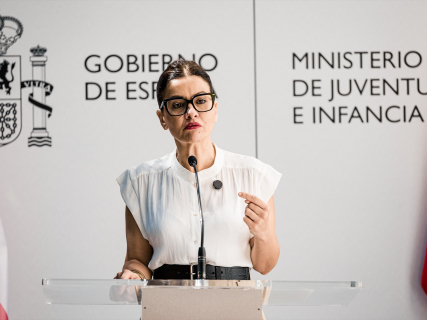

The Minister of Youth and Childhood, Sira Rego, trusts that the Law for the Protection of Minors in Digital Environments can be approved "after the summer," once its parliamentary processing is concluded and the latest contributions from the groups are incorporated.
The regulation aims to strengthen the protection of children and adolescents against the risks associated with the use of certain digital platforms and includes access restrictions for minors under 16 years old when social networks cannot guarantee a safe environment.
"The law is currently in parliamentary processing and these latest contributions that have been made to better define the law are already being worked on," Rego explained in an interview granted to Europa Press before the migration crisis recorded in Ceuta.
The minister believes that the future legislation will represent "a turning point" in the protection of the rights of children on the internet.
Rego focuses on large platforms
One of the main objectives of the Government is to shift the responsibility for the protection of minors from families to the tech companies themselves.
Rego argues that the Executive has made "an effort" to "place the responsibility where it belongs", that is, on the large digital platforms.
"This cannot continue to be the law of the jungle," the minister stated, defending that it should be the social networks that have to ensure their services are safe for minors.
According to Rego, parents should not have to bear the control of the risks arising from algorithms, content, or mechanisms designed by tech companies alone.
"It is the platforms, it is the social networks that have to guarantee that the environment is safe and, therefore, they have to manage the limit, not the families," she pointed out.
The CNMC will have to authorize access for minors
PSOE and Sumar have agreed on an amendment that introduces new obligations for digital platforms.
Companies will have to demonstrate to the National Commission on Markets and Competition (CNMC) that their services meet certain protection conditions.
Among them, they must show that they do not use addictive designs, that they do not expose minors to harmful content or behaviors, that they adequately protect their privacy, and that they have effective tools against unwanted contacts.
In case of not adapting their services and not having express authorization from the CNMC, the platforms will not be able to allow access to minors under 16 years old.
The measure therefore implies something more complex than a general prohibition of social networks for all minors of that age: access will be conditioned on compliance with certain security requirements.
«Regulation» rather than «prohibition»
The Rego herself has wanted to clarify the scope of the rule and claims to be «in favor of talking about regulation rather than prohibition».
In her opinion, while moving towards a regulated model, administrations must be more demanding with the entry of children and adolescents into certain digital environments.
The minister denounces that a good part of the digital ecosystem currently operates under a kind of «law of the jungle», with opaque algorithms and little transparency about the criteria that determine what content users receive.
Rego argues that this lack of control is particularly problematic when it affects minors.
Mental health, attention, and addictive patterns
The minister has also pointed out the effects that some specialists link to the intensive or unregulated use of certain platforms.
Among the problems cited are the consequences on mental health, attention capacity, or knowledge fixation.
Rego also warns of the existence of platforms designed to generate patterns of compulsive or addictive consumption, one of the elements that the future law aims to limit.
For this reason, she believes that public intervention cannot be limited to establishing a minimum age.
Support for families and alternatives to the digital environment
Youth and Childhood proposes to complement regulation with educational and support measures.
Rego advocates developing «pedagogical mechanisms» for families, within the framework of the National Strategy for Safe Digital Environments, and promoting leisure and socialization alternatives away from screens. The minister rejects, however, an absolute ban on technology.
«It is not about» saying a «radical no» to the digital environment nor adopting «maximalist rejection positions», she has defended. The goal, as she explains, is that the incorporation of children and adolescents into these spaces is gradual, accompanied, and with guarantees, also adapting to their maturation process.
The European framework has limited the initial ambition of the law
Rego recognizes that the Government started from a more demanding position, but assures that European regulation has forced a reduction of some of the initial aspirations of the project.
The minister believes that we will still have to wait for the final text to know precisely how far the obligations imposed on the platforms will go.
Furthermore, once the law is approved, it will be necessary to develop a development regulation that specifies its practical application. The regulation will be integrated, according to Rego, within a broader set of reforms linked to the new technological ecosystem.
Among them, she has cited the Organic Law for the proper use and governance of Artificial Intelligence, the reform of the right to honor, or the Artist Statute, which also regulates the participation of minors under 16 years old in certain artistic activities.
Spain seeks coordination with other countries
The minister also defends that the protection of minors on the internet cannot be addressed solely through national regulations.
“It is not enough with regulations at the state level,” she has assured, demanding greater international coordination to advance towards a global governance of the digital environment.
Rego maintains that there is a growing concern in numerous countries, regardless of the political affiliation of their governments, to establish limits on large platforms.
The issue particularly affects social networks and the way these companies design their algorithms, capture users' attention, or manage minors' data.
France also tries to limit social networks for minors
Spain is not the only European country trying to tighten the rules. At the end of July, the French Parliament approved a regulation aimed at prohibiting the use of social networks for minors under 15 years old.
However, the French Constitutional Council annulled the law on August 14, considering that the measure was disproportionate and affected the right to freedom of expression and communication.
After that decision, the French president, Emmanuel Macron, tasked the prime minister, Sébastien Lecornu, with drafting a new text that is legally compatible with the ruling and with the European framework. The objective of the French Executive remains to push forward the reform before spring 2027.
The Spanish law faces its final stretch
In Spain, the future Law for the protection of minors in digital environments is now facing its last parliamentary phase.
Rego trusts that the text can receive the green light after the summer, although it will still have to overcome the amendment process and definitively close some of its elements.
The fundamental change that the regulation proposes is to shift the center of responsibility: platforms must demonstrate that their services are safe for minors and, if they do not, they will not be able to open the door to them before the age of 16.