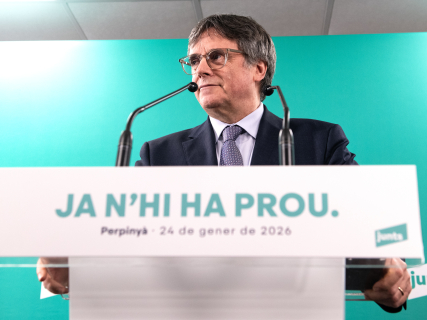
Puigdemont before the 29N: a return without date and without appointment with Sánchez

The possible return of Puigdemont enters the electoral scene of November 29 after Llarena has annulled his arrest order. Pedro Sánchez has celebrated this Tuesday the decision of the Constitutional Court regarding the amnesty, but has ruled out meeting with the leader of Junts when he returns to Spain.

4 minutes

EuropaPress 7240698 presidente junts per catalunya carles puigdemont ofrece declaraciones

EuropaPress 7240698 presidente junts per catalunya carles puigdemont ofrece declaraciones

Add DEMÓCRATA to Google

Ask FREN

Published

Last updated

4 minutes

Most read

The former president of the Generalitat Carles Puigdemont has the possibility of returning to Spain in the weeks leading up to the general elections on November 29. The withdrawal of the national arrest warrant against him clears one of the main judicial obstacles for his return, although his legal situation is still not completely resolved because the effective application of the amnesty to his case is still pending.

The coincidence of judicial timelines with the electoral calendar adds a political dimension to a potential return after years outside of Spain. For now, it is not confirmed when Puigdemont will return nor what role he would play during the electoral campaign, so the scenario will depend on both the upcoming judicial decisions and those made by the former president himself.

The ruling of the Constitutional Court on embezzlement has altered, in any case, a scenario that for years had conditioned any possibility of return. The uncertainty now shifts to when the Supreme Court will complete the application of that doctrine and whether Puigdemont will decide to return before the elections on November 29.

Sánchez celebrates the ruling and rules out a meeting

Pedro Sánchez has defended the decision of the Constitutional Court during the press conference held this Tuesday at La Moncloa. The president of the Government has placed the amnesty and pardons within the political response adopted by his Executive in the face of the Catalan conflict and has claimed those decisions as part of his commitment to coexistence.

The head of the Executive has maintained that the measures adopted in recent years did not respond to the interests of certain political formations, but to the purpose of addressing a problem that he considers to be of a political nature and improving coexistence in Catalonia.

The possible return of Puigdemont, however, will not be accompanied, at least according to the position now expressed by Sánchez, by a meeting between the two leaders. When asked about that possibility, the president was blunt: "I do not contemplate meeting with either a candidate or a politician or another".

Sánchez has linked that response to the scenario opened by the general elections, in which the different forces and their candidates will defend their respective projects before the citizens. At the same time, he has safeguarded the dialogue that may be necessary due to his institutional responsibilities, differentiating it from a possible political meeting during the electoral period.

The position acquires special relevance due to the relationship that PSOE and Junts have maintained during the legislature and because of the weight that the deputies of the independentist formation have had in some of the main votes in Congress. The electoral call now opens a different stage, in which the relationship between both formations is conditioned by the campaign and by the result of the ballots.

Junqueras calls for a new political stage

The decision of the Constitutional Court has also received a response from Oriol Junqueras, who has defended the opening of a new stage once the path to apply the amnesty for the embezzlement linked to the procés has been cleared.

The leader of ERC has demanded that Catalonia be able to democratically decide its future, placing the judicial pronouncement as a step within a political conflict that, from the perspective of the republicans, does not end with the application of the Amnesty Law.

The reaction shows that the progress in the application of the amnesty does not mean the abandonment of the political demands of independence. The resolution of judicial proceedings and the proposals that ERC, Junts, and the rest of the formations bring to the elections on November 29 therefore take place on different planes.

The proximity of the general elections may cause both issues to converge in the coming weeks. Both the situation of Puigdemont and that of Junqueras are crossed by pending judicial decisions just when the independentist formations must define their candidacies and their strategy for the 29N.

The return still has no confirmed calendar

Despite the change in his judicial situation, Puigdemont has not yet set a date to return to Spain. Sources from Junts maintain that the former president will wait for the amnesty to be effectively applied to him before embarking on the return.

This position implies waiting for the Supreme Court to specify the consequences of the doctrine established by the Constitutional Court. The withdrawal of the national arrest warrant eliminates the immediate risk of being arrested in execution of that measure, but it does not yet equate to the definitive closure of his case.

The next milestone will therefore be the resolution adopted by Pablo Llarena once he has analyzed the ruling of the Constitutional Court and its effects on the proceedings opened against Puigdemont. That decision will allow knowing how far the legal change goes and whether the amnesty is finally applied to the former president.

From there, the decision about the moment to return will be political and personal. The proximity of the elections makes it possible for the return to occur during the electoral period, but there is currently no confirmation that Puigdemont will return before November 29 nor that he will participate in campaign events in Spain.

The calendar is thus marked by two distinct unknowns. One corresponds to the Supreme Court, which must complete the judicial response regarding the amnesty; the other, to Puigdemont, who will have to decide when to return and what role he wants to play in the political scenario opened by the general elections.

More key points, information and questions with FREN

AI-GENERATED CONTENT

What is the current status of the parliamentary processing of the Amnesty Law and what are the next steps for its full implementation?

The so-called Amnesty Law is today the Organic Law 1/2024, of June 10, on amnesty for institutional, political, and social normalization in Catalonia. As of October 6, 2026, its parliamentary processing is fully completed, the law has been approved, sanctioned, promulgated, published in the BOE, and is in force since June 11, 2024. What remains open is no longer the legislative process, but its judicial application and the closure of constitutional and European control.

1. Status of parliamentary processing

In strictly parliamentary terms, the sequence has been as follows, according to file 122/000019 and official notes:

  • Start: Organic Law Proposal submitted by the Socialist Group in the Congress.
  • Consideration: approved by the Plenary of the Congress on December 12, 2023.
  • General debate: on January 10, 2024, the total amendments were rejected (33 yes vs. 309 no), so the initiative continued its course.
  • Committee work: Justice Committee, with report and opinion; on March 14, 2024, the Plenary of the Congress approved a new report by absolute majority (178 yes / 172 no).
  • Senate: the text was sent to the Senate, where the PP majority approved a veto to the proposal.
  • Veto lifting: on May 30, 2024, the Congress lifted the Senate veto and ratified the text by 177 votes in favor and 172 against, concluding the parliamentary processing. The Congress published an official note indicating that the law was “definitively approved” and ready for publication in the BOE.

After that moment, the parliamentary initiative is closed. There are no further phases in Congress or Senate regarding this law.

2. Regulatory status: sanction, BOE, and entry into force

The parliamentary processing results in the current regulation:

  • Resulting regulation: Organic Law 1/2024, of June 10, on amnesty for institutional, political, and social normalization in Catalonia.
  • Sanction and promulgation: the law was sanctioned and promulgated by the King on June 10, 2024.
  • Publication: it was published in the BOE no. 141, of June 11, 2024 (text in BOE).
  • Entry into force: the third final provision establishes that the law enters into force the same day of its publication; therefore, it has been in force since June 11, 2024.

No prior regulatory development is required for its application: the law itself defines its scope, effects, and procedure, and directly refers to the competent judicial and administrative bodies.

3. Application: what is underway and what remains

Once in force, the “processing” moves from Parliament to the courts. The law:

  • Amnesties certain criminal, administrative, and accounting acts linked to the procés between November 1, 2011, and November 13, 2023, with specific exclusions (for example, certain cases of terrorism, treason, etc.).
  • Orders the courts and tribunals to apply the amnesty ex officio or at the request of a party, in all affected proceedings and within an abbreviated timeframe.
  • Regulates the effects: case dismissals, extinction of criminal liabilities, lifting of arrest warrants and precautionary measures, review of administrative or accounting sanctions, cancellation of records when appropriate.

In practice, according to the most recent public information, the following occurs:

  • Numerous minor cases or clearly within the scope of the law have already been dismissed or resolved applying the amnesty.
  • Complex proceedings persist, especially those related to embezzlement and the impact on EU financial interests, in which the Supreme Court has been restrictive and several defenses and prosecutors disagree with that interpretation.
  • The Constitutional Court has generally validated the constitutionality of the law, dismissing various unconstitutionality appeals, but continues resolving appeals and issues related to its specific application, especially in cases of procés leaders.
  • The Court of Justice of the EU has been consulted through preliminary rulings and has issued decisions that largely endorse the compatibility of the amnesty with Union Law, which guides the interpretation of Spanish judges.

4. Next steps for its “full application”

In summary, there are no pending steps of parliamentary processing or entry into force. The remaining steps are essentially these:

  • That the courts finish applying the law in all individual proceedings (including those affecting leaders such as Puigdemont, Junqueras, and other relevant defendants).
  • That the Constitutional Court closes all unconstitutionality and protection appeals, establishing a stable doctrine on embezzlement, terrorism, and other limits of the amnesty.
  • That the pending preliminary questions before the CJEU are resolved and that doctrine is incorporated into domestic law.
  • That the derived effects are fully executed (dismissals, lifting of orders, refund of certain fines, closure of accounting files, etc.).

Therefore, the Amnesty Law is already fully in force and operational; what is at stake in 2026 is not its formal approval, but the real scope it will have through the decisions of judges, the Constitutional Court, and, if applicable, the Court of Justice of the EU.

Could you explain in more detail which specific crimes and behaviors are covered and excluded by Organic Law 1/2024 on amnesty? What key rulings has the Constitutional Court issued so far on the Amnesty Law and how have they modified its scope? How is the Supreme Court applying the amnesty in the cases of Puigdemont, Junqueras, and other leaders of the procés, and in what does it differ from the Government or the Prosecutor's Office?

What are the powers and attributions of the President of the Government according to the Spanish Constitution?

The President of the Government is the central figure of the executive power in Spain. His powers are mainly defined in articles 97, 98, 99, 100, and 112 to 115 of the 1978 Spanish Constitution, as well as in subsequent regulations that develop his function. Broadly speaking, the president directs the Government's action, coordinates the ministers, sets the general political orientation, and acts as the main link between the Executive, the Crown, and the Cortes Generales.

1. Direction of Government action and general policy

According to article 97 of the Constitution, the Government directs domestic and foreign policy, the civil and military administration, and the defense of the State, and exercises executive function and regulatory power. Within this collegiate body, the President of the Government is the one who:

  • Determines the general political line of the Government and ensures its unity of action. He is ultimately responsible for the major political orientations (economic, social, foreign, security, etc.).
  • Coordinates the work of the ministers, setting priorities and arbitrating in case of conflicts between departments.
  • Convenes and presides over the Council of Ministers, setting the agenda and leading deliberations.
  • Promotes the drafting of regulations and public policies, giving guidelines to ministries to prepare bills, royal decrees, and strategic plans.
2. Relationship with the King: appointment, dismissal, and countersignature

The President of the Government is appointed by the King, but not at his free discretion, rather after a parliamentary investiture procedure (article 99). The King proposes a candidate, who must obtain the confidence of the Congress of Deputies. Once elected by the Congress, the King formally appoints him.

In exercising his functions, the President of the Government countersigns various acts of the King, that is, assumes political responsibility for them. For example, he intervenes in the proposal of appointments and dismissals of other Government members. Although the formal appointment is made by the King, it is the president who decides whom to appoint and dismiss as minister (article 100, in relation to 98).

3. Internal organization of the Government

The president has broad powers over the organization of the Executive:

  • Propose to the King the appointment and dismissal of ministers. The political design of the Cabinet (which persons occupy each portfolio) corresponds to the president.
  • Restructure the organization of the Government (creation, suppression, or modification of ministries and senior positions within the Presidency's scope, within legal margins).
  • Direct the bodies dependent on the Presidency (for example, the State Secretariat for Communication, advisory cabinets, etc.), which support him in political and strategic coordination.
4. Relationship with the Cortes Generales

The President of the Government has a central role in the relationship with the Legislative Power:

  • Political responsibility before the Congress: the Government responds jointly, but the key figure is the president. The Congress can demand his responsibility through a motion of censure (article 113) and the president can raise a vote of confidence (article 112).
  • Legislative initiative: although the “Government” as a whole has legislative initiative, in practice the president decides the priorities and schedule of strategic bills.
  • Appearances and parliamentary control: the president must appear before the Congress and, if applicable, the Senate, to answer questions, explain general policy or specific matters requested.
5. Power to dissolve the Chambers

A particularly relevant power is to propose the dissolution of the Congress, the Senate, or the Cortes Generales (article 115). The dissolution is formalized by the King through a decree, which must be countersigned by the president. It cannot be agreed if a motion of censure is underway and there are some temporal limits (for example, a new dissolution cannot occur before one year has passed since the previous one, except for specific constitutional cases).

6. Direction of defense and foreign policy

Within the general function of directing domestic and foreign policy and the defense of the State, the president:

  • Leads the Government's foreign action, setting the major lines of international relations, participation in international organizations, and positions in European policy.
  • Directs defense and security policy in coordination with the Minister of Defense and other collegiate bodies, within the constitutional and legal framework.
7. Summary

In sum, the Constitution configures the President of the Government as the political head of the Executive, ultimately responsible for the Government's orientation, coordination of ministers, institutional relationship with the King and the Cortes, and holder of decisive powers such as proposing the appointment and dismissal of ministers or initiating the dissolution of the Chambers. Although many powers are formally attributed to the “Government” as a collegiate body, the president's preeminent position makes him the center of gravity of executive power in the Spanish constitutional system.

Could you explain in more detail what the investiture procedure of the President of the Government consists of? What differences are there between the functions of the President of the Government and those of the King according to the Constitution? How is parliamentary control over the President of the Government articulated in the Congress of Deputies?

What results did Junts per Catalunya obtain in the last general elections and how many deputies does it currently have in the Congress?

In the last general elections held in Spain, on July 23, 2023, Junts per Catalunya obtained a relatively modest representation at the state level, but decisive in parliamentary terms. According to data collected by our information base —which relies on official result records— the formation led by Carles Puigdemont achieved in those elections 395,429 votes, which represents approximately 1.6 % of the valid vote at the state level. That support was concentrated in the Catalan constituencies, mainly in Barcelona and Girona, which are the provinces from which its deputies to the Congress were elected.

The translation of that result into seats was 7 deputies in the Congress of Deputies. In the overall distribution of the lower house (350 seats), Junts was clearly behind the major state forces —PP, PSOE, Vox, and Sumar— and also behind other non-state-wide formations in absolute number of representatives. However, in a very fragmented Congress after 23J, those 7 seats positioned Junts as one of the key actors in several votes of the XV Legislature, especially in those where the Government needed to add support beyond its main partners.

Regarding the current situation derived from those elections, the same sources indicate that Junts maintains the 7 deputies it obtained at the polls. That is, there has been no substantial modification of its number of seats due to resignations, defections, or group changes that alter the initial count. The adjustments that have occurred in the Congress throughout the legislature —temporary absences in different parties, replacements by substitutes, movements within the Mixed Group, etc.— have not significantly affected the size of the Junts group arising from 23J.

However, it is important to introduce an institutional nuance due to the current situation. After the announcement of the dissolution of the Cortes and the call for new general elections for November 29, 2026, the Congress as such is dissolved and the deputies cease to perform their ordinary functions. In this inter-parliamentary scenario, activity between legislatures is channeled through the Permanent Deputation, a reduced body that assumes certain powers until the new Chambers are constituted.

According to available information, Junts currently retains one representative in the Permanent Deputation of the Congress, appointed from among those same 7 deputies elected in 2023. This means that, politically, its weight derived from the last elections remains that of a force with 7 seats obtained at the polls, but with an effective presence reduced to the scope of the Permanent Deputation while the Chamber is dissolved.

Summarizing the two parts of your question:

  • Results in the last general elections (23J 2023): 395,429 votes at the state level, around 1.6 % of the votes, and a total of 7 seats in the Congress, with deputies elected in Catalan constituencies (mainly Barcelona and Girona).
  • Number of deputies currently held: the electoral result of Junts per Catalunya remains at 7 deputies, without relevant modifications during the legislature; after the dissolution of the Congress, one of them is part of the Permanent Deputation until the new Cortes are constituted.

Looking ahead to the next electoral date, the polls being published systematically compare any new estimate with that reference figure: the 7 seats achieved by Junts in the 2023 general elections. That number measures the potential loss or gain of influence of the formation in the Congress in the various polling scenarios considered for November 29.

Could you break down province by province the votes and seats that Junts per Catalunya obtained in the 23J 2023 general elections? What role have the 7 Junts deputies played in the main votes of the Congress during the legislature arising from 23J? How does Junts' result in the 2023 general elections compare with those obtained by the post-convergent space in previous general elections?

Play

Test your knowledge with FREN!

How much do you know about this topic? Answer the following 3 questions.

Why has Carles Puigdemont not yet confirmed the date of his return to Spain?

Question 1 of 3

What has Pedro Sánchez stated regarding a possible meeting with Carles Puigdemont during the election campaign?

Question 2 of 3

What judicial decision eliminated the immediate risk of arrest for Puigdemont?

Question 3 of 3