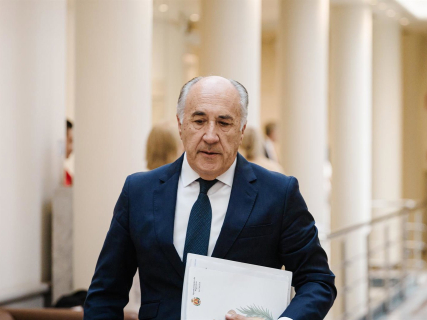
The PP of Cádiz demands the resignation of Landaluce after two complaints for alleged sexual assaults.

The provincial government orders its councilors to withdraw their support for the mayor and abandon their government responsibilities if he does not resign; the mayor denies the facts and claims his presumption of innocence.

3 minutes

fotonoticia 20260826115140 1920

fotonoticia 20260826115140 1920

Add DEMÓCRATA to Google

Ask FREN

Published

Last updated

3 minutes

Most read

The Popular Party of Cádiz has demanded the immediate resignation of José Ignacio Landaluce as mayor of Algeciras after learning of the testimonies of two women affiliated with the party who claim to have filed separate complaints against the mayor for alleged sexual assaults. The provincial leadership has ordered the popular councilors to withdraw their support for the mayor and resign from their responsibilities in the government team if he does not leave office.

The decision represents a change in the party's position, which until now maintained municipal support for the mayor despite the judicial controversies affecting him. Landaluce stopped being a member of the PP in December 2025, but continued at the head of the City Council with the backing of the popular councilors.

The resignation request has the signatures of 12 of the 15 councilors of the municipal government team. The PP of Cádiz has also warned that it will open internal proceedings against the councilors who do not support the decision to withdraw their backing for the mayor.

Landaluce, for his part, has denied the accusations known so far, has asked that his presumption of innocence be respected, and has announced that he will defend himself legally. The mayor has ruled out resigning and has expressed his intention to remain at the head of the City Council.

The PP demands his departure and threatens with proceedings against the councilors

The provincial leadership of the party, led by Bruno García, communicated the decision after meeting with the PP councilors in Algeciras on Monday, October 12. According to the party, it had received information about two complaints related to alleged sexual misconduct attributed to Landaluce.

The party maintains that the known testimonies describe behaviors incompatible with the institutional responsibility and the exemplary conduct required of a mayor. At the same time, it has expressed its respect for the presumption of innocence of the mayor and has indicated that the two women have its support and legal assistance.

The instruction to the councilors includes withdrawing political support for Landaluce and abandoning their responsibilities within the government team if he does not submit his resignation. The provincial leadership has also warned that it will open internal proceedings against those who do not support the measure.

The movement places the popular councilors before the dilemma of supporting their party's demand or maintaining support for the mayor. The provincial leadership has stated that if Landaluce does not resign, it will promote the necessary actions to regain municipal government and ensure the stability of the city.

The accusations and the judicial situation of Landaluce

One of the known accusations was filed on September 2 and attributes to the mayor two alleged sexual assaults that would have occurred in December 2020 and in April or May 2021. According to the account of the complainant, the episodes would have taken place in a medical center owned by Landaluce and in the premises of the City Council. The document also includes a possible crime against public administration related to the alleged offering of a municipal job.

The complaint was initially filed with the Prosecutor's Office and reached the Supreme Court, which requested a report from the Public Ministry on the admissibility of its processing and on the competence of the high court to examine the facts. The procedural situation must be distinguished from the political decision of the PP: the request for resignation does not imply that the accusations have been judicially substantiated.

The second complaint has come to light in recent days and has also been brought to the attention of the provincial leadership of the PP. The party claims that it has received information about two complaints filed by affiliates, although it has not publicly disclosed the full content of both. Therefore, it cannot be assumed that the facts described by the complainants have been proven or anticipate the outcome of the judicial proceedings.

There is a different precedent: the Prosecutor's Office of the Supreme Court archived in January 2026 some proceedings opened as a result of a complaint filed by the PSOE against Landaluce for alleged crimes of embezzlement, influence peddling, and harassment or sexual abuse. That archive referred to that complaint and does not allow us to conclude what the outcome of the subsequently filed complaints will be.

More key points, information and questions with FREN

AI-GENERATED CONTENT

What is the current status of the judicial processing of the complaints against José Ignacio Landaluce?

As of today, the publicly available information indicates that the various complaints against José Ignacio Landaluce are at very different stages and, in the most serious criminal matters, still at very preliminary stages, with no record of an open case with firm charges nor of a scheduled trial.

1. New complaint before the Supreme Court (September 2026)

According to several recent press reports, a PP member from Algeciras filed on September 2, 2026 a complaint before the Criminal Chamber of the Supreme Court against José Ignacio Landaluce for:

  • Two alleged sexual assaults, which would have occurred:
    • in December 2020, at the private medical center he owns, and
    • in spring 2021, in municipal premises.
  • A possible crime against the Public Administration linked to an alleged job offer to the complainant that she had not requested.

The reports agree that, at this moment:

  • The Criminal Chamber of the Supreme Court has requested a report from the Public Prosecutor's Office on whether to admit the complaint and on the Supreme Court's jurisdiction.
  • There is no public record that the Supreme Court has yet agreed to:
    • formally open investigative proceedings against Landaluce, nor
    • carry out actions beyond that request for a report.
  • Therefore, this is a phase of preliminary admission assessment, in which the presumption of innocence fully applies and the facts are only allegations from one party.

An additional element is the issue of parliamentary immunity: the complaint was filed when Landaluce was a senator, which made the Supreme Court's Criminal Chamber competent. After the dissolution of the Parliament, he ceased to be a senator, so the high court must decide:

  • whether to maintain jurisdiction due to the timing of the facts and the complaint, or
  • whether to refer the matter, if applicable, to ordinary judicial bodies (likely an investigating court in the province of Cádiz).
2. Previous complaint by PSOE before the Supreme Court Prosecutor's Office (2025–January 2026)

Previously, another complaint had been processed, promoted by local leaders of the PSOE of Algeciras, also before the Supreme Court Prosecutor's Office, attributing to Landaluce possible crimes of:

  • Embezzlement of public funds,
  • influence peddling, and
  • sexual harassment or abuse.

That complaint led to actions by the Prosecutor's Office, but, according to the press — including the newspaper Demócrata — the Supreme Court Prosecutor's Office agreed to dismiss it on January 15, 2026 due to insufficient evidence of a crime. That dismissal:

  • corresponds to a different case file from the one derived from the new complaint by the PP member,
  • and closes, in that specific area, the criminal route initiated by the PSOE.
3. Cross proceedings initiated by Landaluce

In parallel to the complaints against him, Landaluce has initiated several judicial actions as a plaintiff, which are not “complaints against him,” but are part of the procedural map around the case:

  • Complaint against Rocío Arrabal (PSOE) for alleged crimes of serious slander and libel, filed before the Criminal Chamber of the Andalusian High Court of Justice. It is based on the dissemination, according to Landaluce, of false information about alleged sexual crimes; the complaint follows a conciliation act without agreement.
  • Conciliation claim and possible complaint against María Jesús Montero for statements in which she allegedly called him “convicted” of gender violence. A Madrid court set a conciliation hearing for June 4, 2026, which was later postponed due to notification issues; the procedure is suspended pending a new date.
  • Complaint before the Supreme Court against MEP Luis ‘Alvise’ Pérez for alleged threats or coercion, linked to messages conditioning the publication of compromising material on Landaluce’s resignation. Here the Supreme Court has indeed agreed to open a case and has requested the European Parliament to lift the MEP’s immunity (Demócrata).
4. Summary

Summarizing exclusively regarding the complaints directed against José Ignacio Landaluce:

  • The PSOE complaint for embezzlement, influence peddling, and sexual harassment/abuse was dismissed by the Supreme Court Prosecutor's Office in January 2026.
  • The new complaint by a PP member for alleged sexual assaults and a possible crime against the Public Administration is currently:
    • pending the Prosecutor's report and the Supreme Court's decision on its admission and jurisdiction,
    • with no public record of an open criminal case with charges nor of a trial date.

In the absence of admission, indictment, or conviction rulings, all accusations remain legally mere unproven allegations, and Landaluce maintains, like any citizen, his presumption of innocence until the courts decide otherwise.

Can you detail what arguments the Supreme Court Prosecutor's Office used to dismiss the PSOE complaint against Landaluce? What political consequences have these complaints had for Landaluce's position in the Algeciras City Council and in the PP? How does the admission process of a complaint against a person with parliamentary immunity work in the Supreme Court?

What are the powers and responsibilities of a mayor in a Spanish municipality?

The mayor is the highest single-person body of the municipality and concentrates the political and administrative leadership of the municipality. Its general regime is regulated by Law 7/1985, of April 2, Regulating the Bases of Local Regime (LBRL) — especially article 21 —, complemented by the autonomous community's local regime legislation and by the Municipal Organic Regulation (ROM) of each municipality.

1. Basic functions and representative role
  • Institutional representation: the mayor holds the representation of the municipality and the town council in all official acts, relations with other administrations, and public or private entities.
  • Political leadership of the municipal government: sets the general lines of government action, coordinates the councilors, and sets priorities for action in the various municipal services.
  • Convocation and presidency of collegiate bodies: calls and presides over sessions of the Plenary and the Local Government Board, moderates debates, and ensures compliance with the regulations.
2. Non-delegable powers

The LBRL distinguishes a core of powers that the mayor must exercise personally, without being able to delegate them to councilors or the Government Board. Among them, in the general regime of common regime municipalities, stand out:

  • Direction of the government and municipal administration as a whole, maintaining political leadership unity.
  • Calling and presiding over the Plenary and Government Board, as well as deciding with a casting vote in case of a tie in these bodies.
  • Appointing and dismissing deputy mayors and members of the Local Government Board.
  • Raising a vote of confidence before the Plenary, under the terms provided by basic legislation.
  • Senior personnel management and adoption of the most sensitive organizational decisions that cannot be delegated according to the law.
3. Powers delegable to councilors or Government Board

Alongside that non-delegable core, the mayor can delegate many management powers to specific councilors (area councilors) or to the Local Government Board, to make municipal action more agile and specialized. Delegable functions, with the nuances established by the LBRL and autonomous regulations, include:

  • Processing and resolution of contracting procedures within certain economic or typological limits.
  • Ordinary management of municipal services (cleaning, parks and gardens, culture, sports, social services, etc.).
  • Granting of licenses and authorizations not expressly reserved to the Plenary or the mayor himself.
  • Adoption of agreements in matters of urban planning discipline or sanctions when the ROM or delegation decrees so provide.

Delegation must be formalized by mayoral decree, clearly define its scope, and can be revoked at any time.

4. Personnel leadership and internal organization
  • Senior personnel chief: the mayor directs and coordinates the municipal civil servants and labor staff, without prejudice to the technical powers of the secretary, intervention, or other management bodies.
  • Organization of services: can create, suppress, or reorganize areas, councilor offices, and administrative units within the limits set by the LBRL and autonomous public function laws.
  • Disciplinary regime: initiates or resolves, as the case may be, disciplinary proceedings against personnel, respecting basic and autonomous regulations.
5. Economic powers and financial management
  • Budget preparation: directs the preparation of the municipal budget project which, once approved by the Government Board if applicable, is submitted to the Plenary for approval.
  • Budget execution: orders expenses and payments according to approved credits, without prejudice to the mandatory reports from the Intervention.
  • Contracting and assets: acts as contracting body within the limits set by public sector contracting legislation and makes decisions about municipal assets (concessions, disaffection, etc.) when not reserved to the Plenary.
6. Citizen security and local police
  • Highest responsible of the local police: exercises the leadership of the municipal police force and issues basic guidelines on local security and public order, always within the framework of citizen security laws and autonomous police laws.
  • Edicts and service orders: can issue edicts and orders to guarantee coexistence, use of public spaces, or civil protection in emergencies.
7. Urban planning and discipline
  • Management of planning and its execution: promotes the processing of urban plans and urban development projects that, if applicable, must be approved by the Plenary or other bodies.
  • Licenses and urban discipline: directs municipal policy on building and activity licenses, as well as responses to infractions (stop orders, restoration of legality, sanctions), with distribution of powers among Plenary, Government Board, and councilors according to applicable regulations.
8. Role of autonomous laws and organic regulations

Autonomous community local regime laws and urban planning, police, public function, or own treasury regulations of each community can specify, develop, or nuance these powers (for example, setting which matters necessarily correspond to the Plenary or configuring special regimes for large cities).

The Municipal Organic Regulation internally distributes functions, details delegations, regulates the functioning of the Plenary, Government Board, and commissions, and specifies how the mayor exercises his powers, always within the margins set by the LBRL and autonomous regulations.

Can you detail which specific powers are non-delegable for the mayor according to the Law on Bases of Local Regime? How are powers divided between the mayor and the Plenary regarding municipal budget and contracting? What differences exist between the powers of a mayor of a small municipality and those of a large municipality or provincial capital?

What legal requirements must a party meet to open disciplinary proceedings against its councilors?

A political party in Spain can open disciplinary proceedings against its councilors, but not in just any way: its disciplinary power is strongly conditioned by the Constitution, the Organic Law of Political Parties, and its own statutes, and is controlled by the courts. The key is to combine internal autonomy with respect for fundamental rights and the representative (not imperative) nature of the councilor's office.

1. Constitutional and legal basis

From the Constitution:

  • Art. 6 CE: recognizes parties as fundamental instruments of political participation and guarantees them organizational autonomy, provided their structure and functioning are democratic.
  • Art. 22 CE (right of association) and art. 23 CE (political participation): condition the validity of sanctions that limit the political activity of an officeholder.
  • Prohibition of imperative mandate (art. 67.2 CE, projected to the local level): the councilor represents the citizens, not the party, and cannot lose the seat for disobeying internal instructions.

From ordinary legislation, notable are:

  • Organic Law of Political Parties (LO 6/2002): requires that statutes regulate the disciplinary regime respectfully of members' rights, with guarantees and appeal channels.
  • Electoral and local regime regulations (LOREG and Law on Bases of Local Regime): the councilor's seat is personal. Expulsion from the party may affect membership in the municipal group but does not by itself imply loss of office.
2. What the party can sanction (principle of internal legality)

To validly open disciplinary proceedings, the party must at least comply with:

  • Prior typification: sanctionable behaviors (indiscipline, misuse of office, damage to the party's image, etc.) must be described in the statutes or internal regulations, with a catalog of infractions and sanctions.
  • Proportionality: the sanction (warning, suspension of membership, disqualification for internal positions, expulsion…) must bear a reasonable relation to the gravity of the facts.
  • Respect for fundamental rights: legitimate political opinions, reasonable internal criticism, or exercise of rights such as freedom of expression or participation in party bodies cannot be sanctioned unless concretely typified in the statutes.
3. Minimum procedural guarantees

Although each party designs its own procedure, to withstand possible judicial review it must include at least:

  • Identified competent body: statutes must indicate which body opens the proceedings, who instructs, and who resolves. Sanctions de facto by leaders without formal competence are invalid.
  • Notification of charges: the councilor must be informed in writing of the alleged facts, the internal rule allegedly violated, and the possible sanction.
  • Hearing and defense: reasonable time to submit written allegations, propose and, if applicable, produce evidence; possibility of assistance by lawyer or trusted advisor.
  • Reasoned resolution: the sanctioning decision must explain the proven facts, the applied rule, and reasons for the proportionality of the sanction.
  • Internal appeal: usually before a higher body (guarantees committee, ethics commission, etc.), with clear deadlines and effects, all recorded in statutes or disciplinary regulations.
  • Internal publicity of rules: disciplinary rules must be accessible to members and public officeholders (circulars, internal website, registration documentation, etc.).
4. Party discipline and the councilor's mandate

The party can:

  • Require voting discipline or coherence with the political line in the municipal group and sanction internal breaches.
  • Decide on expulsion of the member or separation from the municipal group, according to statutes and plenary regulations.

But it cannot:

  • Legally force the councilor to relinquish their seat. If they do, it will be political or moral pressure, not an automatic legal effect.
  • Transform the internal sanction into a cause of incompatibility or loss of office beyond what the law provides.

Courts (usually civil jurisdiction and, depending on the case, administrative contentious jurisdiction) can review:

  • Whether the party respected its own statutes and procedural guarantees.
  • Whether the sanction violates fundamental rights (expression, association, political participation, effective judicial protection).
5. Good practices to safeguard the proceedings

Besides what is strictly required by law, it is highly recommended to:

  • Clearly separate investigating body and sanctioning body, to reinforce impartiality.
  • Document everything in writing (complaint or initiation agreement, investigation proceedings, hearing and evidence minutes, final agreement).
  • Avoid public statements of presumed guilt by party leaders that could be used to claim partiality or defenselessness.
  • Provide in statutes specific channels for public officeholders (councilors, deputies…) considering their dual role: party members and elected representatives.
  • Clearly inform the councilor that the sanction does not by itself affect the seat, distinguishing internal effects (membership, positions, group membership) from external ones (relationship with the municipality).

In sum, a party can and should exercise discipline over its councilors, but always based on clear internal rules, respecting procedural guarantees, and without turning that discipline into an imperative mandate contrary to the Constitution or an indirect way to deprive the elected representative of their office.

Can you explain with concrete examples what behaviors of a councilor usually lead to disciplinary proceedings by their party? What judicial avenues does a councilor have to challenge a disciplinary sanction from their party and what are the approximate deadlines? How do municipal organic regulations usually regulate the situation of councilors expelled from their party or municipal group?

Play

Test your knowledge with FREN!

How much do you know about this topic? Answer the following 3 questions.

Why has the PP of Cádiz requested the resignation of Mayor José Ignacio Landaluce?

Question 1 of 3

How many councilors from the municipal government team have signed the request for Landaluce's resignation?

Question 2 of 3

What has Landaluce stated in response to the accusations?

Question 3 of 3