
The Renfe AVE that collided this Wednesday with a stopped Iryo in Urda (Toledo) was traveling at an estimated speed of between 160 and 200 kilometers per hour at the moment of impact, according to the first information note from the Independent Authority for the Technical Investigation of Accidents (AITAT), released after the first 24 hours had elapsed since the railway accident that has left at least 69 dead.
The document includes a first technical estimate of the speed at which the collision occurred, one of the main unresolved questions since the circumstances of the accident became known. However, the figure is still not definitive, as investigators must compare it with the information stored in the train recorders, commonly known as black boxes.
AITAT specifies that the exact speed will be determined when the data from the "onboard legal recorder" are extracted. These devices remain in the custody of the Guardia Civil, which is acting as judicial police in the proceedings opened to clarify the circumstances of the tragedy.
The AVE struck the Iryo when it was stopped before an entry signal
The preliminary reconstruction contained in the report confirms that the Iryo remained immobilized before the E242 entry signal of the Urda station when it was struck from behind by the AVE.
The collision occurred after a computer incident in the railway protection system LZB that had affected the circulation of six trains on the Madrid-Seville high-speed line. According to the explanations offered by the Ministry of Transport, the Adif control center in Atocha authorized the AVE to resume its journey, while the Iryo continued stopped in the vicinity of Urda.
The estimated speed in the first technical report adds a relevant element to the reconstruction of the events, although by itself it does not allow establishing the causes of the accident or determining the responsibilities of the people who intervened in the management of the traffic.
Two cars ended up overturned at the foot of the embankment
The AITAT note also describes the damage suffered by both convoys and the arrangement in which their vehicles remained after the impact.
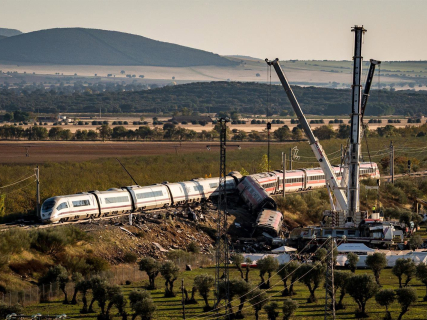
According to the investigative body, the front car of the AVE, identified as car 8 in the train numbering, was embedded in the rear car of the Iryo, identified as car 1. Both ended up overturned and turned at the foot of the embankment of the track.
The rest of the AVE also derailed. The last six cars, numbered from 1 to 6 according to the identification of the convoy, remained on the railway platform, while car 7 fell down the embankment.
This description makes it possible to specify the extent of the material damage and the final position of the vehicles, two aspects that must be incorporated into the technical analysis of the accident together with the traffic records and the communications between the train drivers and the control center.
The black boxes must specify the speed of the impact
The investigation must now determine the exact speed of the AVE and reconstruct the conditions in which it was traveling before reaching the Iryo. For this, the analysis of the onboard recorders will be essential, whose data will make it possible to compare the initial estimate of between 160 and 200 kilometers per hour.
The first technical note does not constitute a definitive conclusion on the causes of the accident. Its content documents the initial known circumstances and the state of the trains after the collision, while judicial proceedings and the investigations aimed at clarifying how the collision occurred continue.