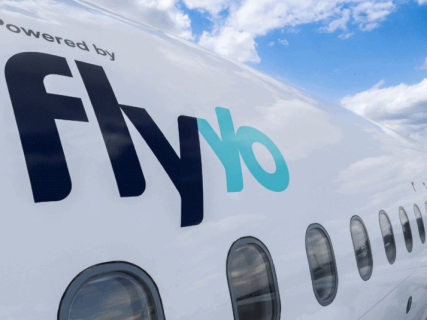
This is how the flight map of Galicia changes with Fly2Galicia: these are the six new routes from Santiago

The new company will launch in December connections with Granada, Zaragoza, Milan, Munich, Prague, and Venice that are not currently listed in the Lavacolla offer. Alicante and Brussels are already included in Aena's schedule, while Wizz Air is also preparing its arrival in Zaragoza.

4 minutes

WhatsApp Image 2026 08 20 at 16.13.06

WhatsApp Image 2026 08 20 at 16.13.06

Add DEMÓCRATA to Google

Ask FREN

Published

Last updated

4 minutes

Most read

Fly2Galicia plans to start its operations on December 1, 2026 with an Airbus A320 based in Santiago and 17 weekly frequencies to Alicante, Zaragoza, Granada, Brussels, Munich, Milan-Malpensa, Prague, and Venice.

The comparison with the schedule that Aena currently publishes for Santiago allows for a better measurement of the announcement's scope. Of those eight destinations, only Alicante and Brussels-Charleroi now appear among the direct connections of the Santiago airport, both operated by Ryanair.

The scenario, however, will change before the year ends. Wizz Air will also launch a connection between Santiago and Zaragoza in December, which will make Fly2Galicia not the only company to recover that link.

What routes of Fly2Galicia are new from Santiago

The current map of destinations published by Aena does not include direct flights from Santiago to Granada, Zaragoza, Milan, Munich, Prague, or Venice. This means that six of the eight connections announced by Fly2Galicia represent, regarding the current offer, the incorporation or recovery of destinations that are not currently available from Lavacolla.

The situation is different in Alicante and Brussels-Charleroi. Both cities are currently part of the airport's network and Ryanair is listed as the operator of both connections.

In Zaragoza, there is an added nuance: the route does not currently exist from Santiago, but Wizz Air has announced that it will also start operating it in December. The Concello de Santiago has presented that connection as the recovery of a lost route months ago.

Fly2Galicia Route Is there currently from Santiago? Competition / situation Is there from A Coruña or Vigo? Announced price
Alicante Yes Ryanair currently figures on the route Not in the current Aena schedule* From 19 €
Zaragoza No Wizz Air plans to launch it also in December No From 19 €
Granada No No current direct connection from Santiago No From 19 €
Brussels Yes, via Charleroi Ryanair currently operates Santiago-Charleroi No From 39 €
Milán-Malpensa No New from Santiago Yes, from A Coruña From 39 €
Munich No No current direct connection from Santiago No From 49 €
Prague No No current direct connection from Santiago No From 49 €
Venice No No current direct connection from Santiago No From 49 €

Alicante and Brussels: the two routes that Santiago already has

The most direct competition that can be identified with the current schedule is concentrated in Alicante and Brussels. Aena currently includes Alicante-Elche and Brussels-Charleroi among the destinations from Santiago. In both cases, Ryanair appears as the operating company.

Fly2Galicia proposes for Alicante three weekly frequencies, one more than the two planned for each of the other seven routes. The announced fare will start from 19 euros.

In Brussels, tickets have been announced from 39 euros. There is, however, a necessary caution when comparing both offers: the initial information from Fly2Galicia speaks of Brussels without publicly specifying in all its communications the airport, while Ryanair connects Santiago with Charleroi.

Zaragoza will have two new operators

Zaragoza represents a different case. It does not currently appear among the Lavacolla destinations published by Aena, but two companies intend to fly the route during the next winter.

Fly2Galicia has precisely chosen Santiago-Zaragoza for its inaugural flight on December 1. The company will offer two weekly frequencies and tickets from 19 euros.

Wizz Air also plans to incorporate Zaragoza into its new base in Santiago during December. The link is part of the expansion with which the airline will add domestic flights to Gran Canaria, Fuerteventura, Tenerife North, Malaga, and Zaragoza, in addition to Rome and Warsaw internationally.

If both schedules are maintained, Zaragoza will be one of the first routes in which Fly2Galicia will have direct competition from the start of its operations.

Milán, the connection that already exists from A Coruña

The map changes when expanding the comparison to the other two Galician airports.

Aena currently includes Milán-Malpensa among the direct destinations from A Coruña, while it does not appear among the current connections from Santiago or Vigo.

The connection between A Coruña and Malpensa is being operated by easyJet, with two weekly flights in part of its schedule and availability also announced for the following months.

Therefore, Fly2Galicia will introduce a new route for Santiago, but not an unprecedented connection for the whole of Galicia.

This overlap has already entered the institutional debate. The Concello de A Coruña has requested greater coordination between the Galician airports and has specifically pointed out Alicante and Milan when questioning the duplication of some connections.

Vigo currently has none of the eight routes

The difference is greater in Peinador.

The current Aena schedule for Vigo only includes direct connections with Barcelona, Gran Canaria, Madrid, Palma de Mallorca, Santander, and Tenerife North. None of the eight initial destinations of Fly2Galicia currently appear in that list.

Fly2Galicia, in any case, has not closed the door to expanding its presence. Its manager, Gueorgui Iavorov Popov, has indicated that the company could study in the future bases in both Vigo and A Coruña, although for now there are no specific routes announced from either of the two airports.

Six destinations that Santiago does not currently offer

The main effect of Fly2Galicia will therefore be to expand the range of direct connections from Santiago.

Granada, Zaragoza, Milan, Munich, Prague, and Venice do not currently appear among the 29 destinations published by Aena for Rosalía de Castro. Alicante and Brussels are present, and Zaragoza will also be included in Wizz Air's offer during the winter.

The Galician aerial photograph will be different when Fly2Galicia begins operations in December: some routes will recover lost connections, others will introduce European destinations absent from Lavacolla, and several will open new competition between airlines or between the Santiago, A Coruña, and Vigo airports themselves.

More key points, information and questions with FREN

AI-GENERATED CONTENT

What procedures must Fly2Galicia complete to obtain operating permits and slots at Santiago airport?

For a company like Fly2Galicia to operate regular commercial flights at Santiago de Compostela Airport (SCQ), it must complete several blocks of procedures: certification as an air operator, economic licenses, safety requirements and insurance, and, in parallel, obtaining slots and contracts with AENA. Many steps overlap in time, but some are absolutely essential before takeoff.

1. State certification and licenses (AESA / Ministry)

The core of the process lies with the State Aviation Safety Agency (AESA) and the competent Ministry for air transport:

  • Company formation and structure: create the company, define shareholders and management body, business plan and fleet plan, operations manual and safety organization (responsible manager, operations manager, maintenance, etc.).
  • Air Operator Certificate (AOC): AESA evaluates that the airline has the technical and organizational capacity to operate safely. They review:
    • Manuals (operations, maintenance, training, safety management system/SMS).
    • Crew and qualified technical personnel.
    • Maintenance, handling, fuel contracts, etc.
    • Tests and demonstrations of procedures.
    The AOC is essential to operate regular commercial flights.
  • Operating license (Community air operator license): this is the economic authorization to operate air services. In the EU it requires:
    • Registered office and effective control in a Member State.
    • Majority capital and control by persons or companies from the EU.
    • Financial solvency proven to cover at least 3 months of operating costs.
    It is usually processed in parallel with the AOC, but the license is conditional on the effective obtaining of the certificate.
  • Aircraft registration in the Spanish Aircraft Registry (or another Member State) and annotation of operation by Fly2Galicia.

2. Operational safety and mandatory insurance

Before operating, the airline must demonstrate:

  • Implementation of a Safety Management System (SMS), with risk analysis, incident reporting, and safety culture.
  • Compliance with EASA regulations on continuous airworthiness maintenance (CAMO/Part-CAMO) and operations (Part-OPS).
  • Mandatory insurance:
    • Civil liability towards passengers, baggage, and cargo (Regulation (EC) 785/2004).
    • Liability towards third parties on the ground.
    • Other insurances that may be required by contracts with AENA or suppliers.

Without this insurance coverage and safety systems approved by AESA, it is impossible to operate legally.

3. Slots and permits at Santiago airport

Santiago de Compostela Airport is managed by AENA and subject to European slot rules when saturated.

  • Contractual relationship with AENA:
    • Registration as an airport client and signing of service contracts.
    • Determination of operations: bases, offices, counters, warehouses, etc.
    • Acceptance of airport fees (landing, passengers, security, parking, jet bridge, etc.).
  • Obtaining slots:
    • Slots are allocated according to the European slot regulation and coordination systems (Spain has a designated coordinator).
    • Fly2Galicia must request time slots for takeoffs and landings in the IATA seasons (summer/winter), indicating route, aircraft type, and frequency.
    • The coordinator assigns slots based on the declared airport capacity and availability. At less congested airports, allocation is more flexible but follows the same legal framework.
  • Handling and security permits:
    • Contract or certify ground handling services (own or third-party) authorized at Santiago.
    • Comply with airport security regulations (access controls, AVSEC training, personnel accreditation for restricted areas, etc.).

4. European dimension and traffic rights

If Fly2Galicia is a Community operator with an AOC and license from an EU Member State, it enjoys the freedom to provide air services within the EU without additional bilateral authorizations. However:

  • It must fully comply with EASA regulations (crew licenses, maintenance, operations, etc.).
  • For routes to third countries (outside the EU/European Economic Area), the following may be required:
    • Traffic rights under bilateral or EU–third country agreements.
    • Specific authorizations from the destination country’s authority.

5. What is essential and what can be done in parallel

  • Essential before the first commercial flight:
    • Valid AOC.
    • Operating license.
    • Registered aircraft assigned to the operator.
    • Mandatory insurance.
    • Confirmed slots (when applicable) and operational contract with AENA for use of facilities.
  • In parallel or adjustable in later phases:
    • Expansion of route network and additional slots.
    • Development of operational bases and own offices at the airport.
    • Complementary services (interline agreements, loyalty programs, codeshares).

Practically, Fly2Galicia should plan the certification schedule with AESA and the negotiation of slots and services with AENA in an integrated way, to start operations in Santiago with all critical permits granted and room to adjust schedules and capacity according to demand.

What approximate timelines does it usually take to obtain the AOC and operating license for a new airline like Fly2Galicia? What specific fees would AENA charge Fly2Galicia for operating domestic and European flights from Santiago? What slot request strategy would be most appropriate for Fly2Galicia to enter routes already operated from Santiago without losing competitiveness?

What are the competencies of the Concello de Santiago in the management and coordination of air connections?

The Concello de Santiago plays a relevant role in the promotion and political coordination around Santiago-Rosalía de Castro Airport, but its competencies over air connections are fundamentally indirect and supportive. The capacity to decide routes, manage the airport, or set tariffs corresponds to the State and AENA.

1. Basic legal framework and competency limits

  • Several official documents recall that, according to Article 149.1.20 of the Constitution, the competence over airports of general interest is exclusive to the State, and management corresponds to AENA (for example, notes from the Xunta collected in this statement).
  • Law 48/1960 on Air Navigation and Law 21/2003 on Air Safety, recently amended by the Air Navigation and Safety Bill, consolidate this scheme: the State and AENA plan and manage airports of general interest, their master plans, aeronautical easements, etc.
  • In Galicia, the Xunta assumes a role in origin promotion and co-financing of routes, but insists that airport competence is state and that the community “only promotes Galicia at origin and does not subsidize flights” (note from 9/4/2025, available here).

Within this framework, the Concello de Santiago cannot authorize flights, impose or organize routes, manage infrastructure, nor regulate tariffs or airport fees.

2. Competencies and functions of the Concello de Santiago

a) Tourism and economic promotion linked to the airport
  • The Concello acts as a destination administration: it designs and executes tourism promotion policies for Santiago and its surroundings, in coordination with the Xunta and Turespaña.
  • The Xunta and the City Council have signed and extended a Destination Tourism Sustainability Plan in Santiago (second addendum published in the BOE on 03/26/2026: link), which finances tourism management actions in the city, some of which rely on air connectivity.
  • In a meeting between Turismo de Galicia and the City Council (note from 5/7/2026, link), both administrations commit to sharing visitor flow data and coordinating actions, including the “airport scope,” to reduce seasonality and better manage tourist arrivals.
b) Participation in bodies and working groups on connectivity
  • The Concello participates, through its Tourism council, in the Galicia air connectivity working group created within the Airport Coordination Committee, where the State, Xunta, municipalities, and private sector are represented (see Xunta notes from 11/5/2025 and 5/20/2026, for example here).
  • In this forum, the City Council can raise connectivity needs, support proposals for new routes, and give opinions on the specialization and coordination of the three Galician airports, although final decisions are made by the State and AENA.
c) Collaboration in route promotion
  • The current Galician strategy is based on “origin promotion”, mainly financed by the Xunta (€13 million annually and up to €100,000 per new route and airport, according to the note from 5/20/2026, link).
  • The Xunta itself “invites” other administrations, including the Concello de Santiago, to join financially or in kind these coordinated route promotion campaigns.
  • The City Council also participates in specific promotion agreements for the Newark–Santiago route through Turespaña and United, focused on destination marketing (note from 8/12/2026: link).
d) Direct relationship with airlines and private projects
  • In practice, the Concello holds meetings and contacts with airlines and project promoters (such as the recent case of Fly2Galicia, which claims to have worked “in coordination with Aena and the Santiago City Council” and had conversations with the Xunta, according to Demócrata in this article).
  • These meetings fall within its competencies of economic and tourism promotion: evaluating projects, providing institutional support, coordinating public messages, and, if applicable, facilitating information about the city and its surroundings.
e) Ground mobility and urban access
  • The City Council does have direct competence over urban transport (city buses, taxis) and over road and urban planning that facilitates access to the airport from the city.
  • While the Xunta organizes interurban services (such as bus reinforcements due to temporary closures of other airports), the Concello can adapt its urban network, stops, taxi licenses, etc., to better integrate the airport into Santiago’s daily mobility.

3. Summary

In summary, the Concello de Santiago does not “manage” or “legally coordinate” air connections, because that power resides with the State and AENA. Its competencies focus on:

  • Tourism and city promotion linked to air connectivity.
  • Participation and voice in coordination bodies (Airport Coordination Committee, connectivity working groups).
  • Economic or institutional collaboration in route promotion campaigns driven by Xunta, Turespaña, and airlines.
  • Local planning of access and urban transport to and from the airport.

Its role is therefore that of a key actor in destination policy and institutional dialogue, but without executive competencies over airport management or flight scheduling.

Can you detail exactly what the Tourism Sustainability Plan agreement between the Concello de Santiago, the Xunta, and Turespaña says about the airport? What role does the Galicia Airport Coordination Committee have and how does the Santiago City Council participate in it? How does Santiago’s air connectivity fit into the Galician origin promotion strategy and what impact does it have on other Galician cities?

What has been the professional career of Gueorgui Iavorov Popov before leading Fly2Galicia?

The available information about the professional career of Gueorgui Iavorov Popov before leading the Fly2Galicia project is very limited. The sources consulted (including specialized news from Demócrata and institutional databases) only reliably reconstruct one specific business background —the company Alpha Tour Europe S.L.— and some statements by the promoter himself about his experience in aviation, tourism, and transport sectors. However, there is no detailed CV or previous positions in major airlines or Spanish public administrations.

Previous business activity: Alpha Tour Europe S.L.

The only clearly documented professional project prior to Fly2Galicia is Alpha Tour Europe S.L.:

  • According to Demócrata’s analysis of who is behind Fly2Galicia, Gueorgui Iavorov Popov founded in 2022 the company Alpha Tour Europe S.L. as a sole proprietorship, with a share capital of 3,000 euros and dedicated to tour operator activities.
  • The project was presented as an initiative linked to air tourism, announcing connections between Palma de Mallorca and several cities in Germany.
  • In a contextual piece about Fly2Galicia, Popov himself states that Alpha Tour Europe carried out eight charter flights during Easter 2022 for a German client, in a very limited format and without the intention of becoming a regular airline.
  • However, the in-depth report by Demócrata emphasizes that, from the sector’s point of view, that project was received as an initiative that “announced” regular routes but whose flights “ultimately did not operate” as a stable program, which explains some of the caution now surrounding Fly2Galicia.

In summary, the main verifiable professional background of Iavorov Popov in the business field before Fly2Galicia is the launch of Alpha Tour Europe S.L., linked to charter operations and marketing of tourist flights from Spain to Germany, with very limited scope and no known continuity.

Links with Fly2Galicia and corporate structure

Although already part of the current stage, the news provides some data that help understand the evolution of his business profile:

  • In January 2026, Aviation & Mobility Services Group S.L. was established in Santiago de Compostela, the parent company using the commercial brand Fly2Galicia.
  • The Official Gazette of the Commercial Registry lists Gueorgui Iavorov Popov Popov as sole shareholder and administrator of this company, with an initial share capital of 1 euro and classified under travel agencies.
  • From there, he promotes the “virtual airline” model that markets flights under the Fly2Galicia brand by contracting a European air operator with its own AOC and license.

Although these data belong to the Fly2Galicia stage, they show the continuity of a tourism-air sector entrepreneur profile moving from a charter and tour operation project (Alpha Tour Europe) to a more ambitious regional air brand scheme based on ACMI contracts.

Claimed experience and information gaps

In interviews and statements collected by Demócrata, Popov claims to have “more than ten years of professional experience” in activities related to aviation, tourism, and transport. However:

  • The journalistic information consulted does not specify in which companies, countries, or positions he would have developed that supposed decade of experience.
  • Databases of official appointments and positions in public bodies do not show records of Gueorgui Iavorov Popov as an executive or board member in Spanish administrations, public companies, or large listed companies.
  • His profiles do not appear in usual directories of senior executives in the European air sector prior to the creation of Alpha Tour Europe.

This implies that, beyond the two identified companies (Alpha Tour Europe S.L. and Aviation & Mobility Services Group S.L.) and his own general statements about his experience, there is no detailed public CV that allows tracing his professional career precisely: no previous positions, academic background, or participation in other clearly documented business projects.

Conclusion

With the information available in commercial registries and specialized press, the known professional career of Gueorgui Iavorov Popov before leading Fly2Galicia is summarized as his role as promoter and owner of Alpha Tour Europe S.L., a limited scope tour operation and charter flight initiative, and his self-definition as a professional with more than a decade of experience in aviation, tourism, and transport. Outside that framework, no positions in major airlines, listed companies, or Spanish public administrations have been found to complete a broader biographical profile.

Can you detail exactly what is known about Alpha Tour Europe S.L. and why it is considered a relevant background to assess Fly2Galicia? What doubts and risks do press reports highlight about the Fly2Galicia project and its promoter? How are virtual airline models and ACMI contracts that Fly2Galicia plans to use regulated in Spain?

Play

Test your knowledge with FREN!

How much do you know about this topic? Answer the following 3 questions.

On what date does Fly2Galicia plan to start its operations from Santiago?

Question 1 of 3

Which destinations will be new direct routes from Santiago with Fly2Galicia compared to the current offer?

Question 2 of 3

Which company has also announced the opening of the Santiago-Zaragoza route for December?

Question 3 of 3

Hola, soy Fren. ¿Cómo te ayudo?