
The European Commission has taken a new step to strengthen oversight over ChatGPT in the European Union. The community executive has designated this Monday the artificial intelligence service as Large Online Search Engine (VLOSE) under the Digital Services Act (DSA), a classification that subjects the company to a regime of reinforced obligations and will allow Brussels to investigate the functionalities behind the service and, when appropriate, the related systems.
The decision comes after ChatGPT declared that it reaches an average of at least 45 million monthly users in the European Union, the threshold established by community regulations for a service to be considered a very large platform or search engine. Alongside ChatGPT, the Commission has also designated Reddit and Roblox as Large Online Platforms (VLOPs). The new classification does not imply, by itself, that Brussels has found a violation of regulations by ChatGPT. Instead, it represents the activation of a more demanding oversight framework, justified by the scope and potential impact these services have on European citizens.

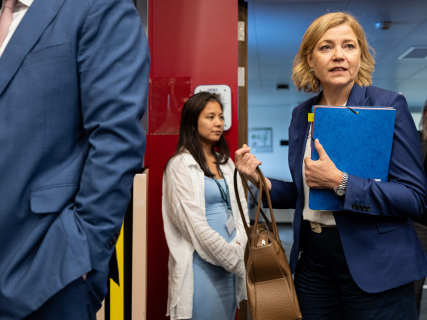
"These new designations mean that ChatGPT, Reddit, and Roblox will now be subject to a higher level of scrutiny and accountability in the European Union, in line with the significant impact they have on our citizens and society," said the Executive Vice-President of the European Commission responsible for Technological Sovereignty, Security, and Democracy, Henna Virkkunen.
The commissioner added that Brussels will continue to monitor the evolution of the European digital ecosystem and will not hesitate to designate those platforms that reach the threshold set by legislation to be subject to reinforced oversight.
Four months to adapt
The designation now opens a period of four months, until the end of November 2026, for ChatGPT, Reddit, and Roblox to comply with the additional obligations established by the Digital Services Act for large platforms and search engines. These obligations are especially related to the "identification, assessment, and mitigation of systemic risks associated with digital services," according to community sources. The regulation requires designated platforms to analyze the risks that may arise from their systems and the dissemination of illegal content, but also those related to issues of special sensitivity for the European Union.
Among them are the negative effects on minors, the physical and mental well-being of users, the protection of fundamental rights, electoral processes, and public safety. The regulatory logic of Brussels is based on the premise that the size and reach of certain platforms mean that their potential effects on society are substantially greater than those of other digital services. Therefore, the DSA establishes a specific regime for those companies that exceed certain levels of usage within the European market.

In the case of ChatGPT, the particularity also lies in the very nature of the service. The Commission considers that the artificial intelligence system can interact with users, respond to their requests and inquiries, and perform web searches. This combination of functionalities leads the community executive to consider that it is a hybrid service that can be classified as an online search engine for the purposes of the DSA.
The classification is particularly relevant because it expands the scope of application of the reinforced obligations of the Digital Services Act to a service based on generative artificial intelligence.
Brussels gains new investigative powers
The designation as VLOSE not only implies new obligations for ChatGPT. It also modifies the supervisory capabilities of European institutions. From now on, the European Commission will be competent to directly supervise the compliance of the DSA by the service, in cooperation with the corresponding national authorities.
Specifically, Brussels will have investigative powers to assess the functionalities that support these services and, when appropriate, any related system. In the case of ChatGPT and Reddit, the Commission will work alongside the Coimisiún na Meán, the Digital Services Coordinator of Ireland, the country where both services are established. For Roblox, cooperation will be developed with the Authority for Consumers and Markets of the Netherlands (ACM), which acts as the Dutch Digital Services Coordinator.

This distribution of competencies reflects the supervision model designed by the DSA, which distributes responsibilities between the Commission and the Digital Services Coordinators of the Member States. However, for platforms and search engines considered very large, the community executive takes on a central role in monitoring compliance with the reinforced obligations. ChatGPT, Reddit, and Roblox were already subject to the general obligations provided by the DSA for online platforms and online search engines. The novelty of the decision this Monday is that, after surpassing the established threshold, they are now subject to the specific regime designed for services with sufficient scale to generate systemic risks in the European digital environment.
A new front for the regulation of artificial intelligence
The inclusion of ChatGPT in this category also opens a new front in the European regulatory strategy on artificial intelligence. The European Union has built in recent years an increasingly broad regulatory framework to regulate the digital ecosystem, with specific rules on artificial intelligence, platforms, data, competition, and digital markets.
The Commission's decision shows how European regulation of AI is not limited to the internal functioning of the models, but also extends to the services built on these technologies when they acquire a sufficient dimension within the community market. In this case, the determining element for the designation is not only that ChatGPT uses artificial intelligence, but the volume of users and the functionalities it offers to European citizens. The Commission considers that the service's ability to interact with users and provide answers, including those obtained through internet searches, allows it to fit within the category of online search engine contemplated by the DSA.
The issue takes on special relevance due to the growing role of these systems as intermediaries for accessing information. The ability of AI models to directly answer questions can modify the way users consult content on the internet and, with that, generate new risks related to the dissemination of illegal information, the protection of minors, fundamental rights, or the integrity of democratic processes.

Featured story
Democrat enters the debate of the European dilemma on AI: regulate without stifling innovation
6 minutes
In parallel, the Commission keeps the door open to expanding the number of services subject to this regime. To date, Brussels has designated 28 large online platforms and search engines under the Digital Services Act, within a system of shared supervision with national authorities. Executive Vice President Henna Virkkunen has made it clear that the process will continue. "We continue to closely monitor the digital landscape and will not hesitate to designate any platform that meets the threshold for enhanced supervision under the Digital Services Act," she warned.
With the decision on ChatGPT, Brussels incorporates for the first time one of the main generative artificial intelligence services into the enhanced supervision perimeter of the DSA. The next step will be to check how the company adapts its systems and procedures to the new community requirements before the four-month deadline set by the Commission expires.