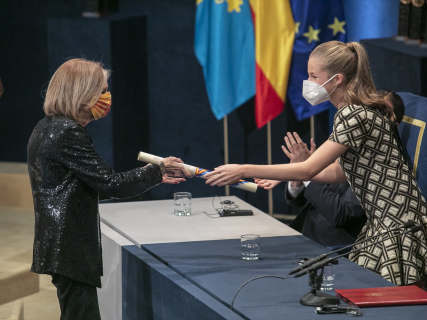

Gloria Steinem has died this Thursday at the age of 92. She was one of the most recognizable and influential voices of the second wave of feminism in the United States. For more than six decades, she advocated for equality between women and men, reproductive rights, and greater female presence in politics, journalism, and spaces of power. In 2021 she received the Princess of Asturias Award for Communication and Humanities.
From undercover journalist to feminist reference
Born on March 25, 1934, in Toledo, Ohio, Gloria Steinem studied at Smith College and later spent two years in India, an experience that influenced her conception of social activism and community organization.
One of her first jobs with greater impact came in 1963 when she infiltrated as a waitress in a Playboy club in New York. The report, published under the title A Bunny’s Tale, denounced the working conditions and treatment received by the female workers. The investigation provided her with notoriety, although it also made it difficult for some time for American publications to assign her issues unrelated to the female condition.
Her consolidation as a feminist leader occurred in 1969 with the publication in New York Magazine of the article After Black Power, Women’s Liberation. The text helped bring the demands of the women's liberation movement into the public debate.
The creation of Ms. and the leap into politics
In 1972, she participated in the founding of Ms., one of the first feminist magazines aimed at a national audience. The publication brought to newsstands issues that had previously been relegated by major media, such as abortion, violence against women, workplace discrimination, caregiving, or the unequal distribution of domestic tasks.
Steinem also contributed to the creation of organizations such as the National Women’s Political Caucus, the Women’s Action Alliance, and, in 2005, the Women’s Media Center, along with Jane Fonda and Robin Morgan.
From those spaces she promoted female political participation, advocated for the Equal Rights Amendment of the United States, and publicly supported the right to abortion. Her activism also extended to the fight against racism, homophobia, apartheid, and various forms of violence and discrimination.
Key figure
The importance of Steinem does not reside solely in her writings, but in her ability to connect journalism, social activism, and political action. She contributed to turning issues considered private —male violence, inequality at home, professional discrimination, or control over reproduction— into matters of public debate.
She also helped to place feminism at the center of major American media. Her enormous visibility made her a symbol of the movement, although she always insisted on its collective nature and the need to especially listen to less represented women.
Her trajectory was not without criticism. Some feminist sectors questioned the prominence she gained as a white, middle-class woman, while others reproached her youthful collaboration with an organization covertly funded by the CIA. Steinem acknowledged that relationship, linked to the participation of American students in international festivals during the Cold War.
Princess of Asturias Award
In 2021, Steinem received the Princess of Asturias Award for Communication and Humanities. At that time, the jury highlighted her role as a essential reference in social transformation in favor of women's rights and the combination of journalism with intense intellectual and political activity.
Among her most well-known works are Scandalous Acts and Everyday Rebellions, Revolution from Within, and My Life on the Road, memoirs in which she recounted a life marked by travel, listening, and the organization of social movements.
With her passing, one of the last great protagonists of the American feminist revolution of the sixties and seventies disappears. Her legacy remains in the transformation of the debate on equality and in generations of journalists and activists who learned from her that personal experience could also be a political issue.