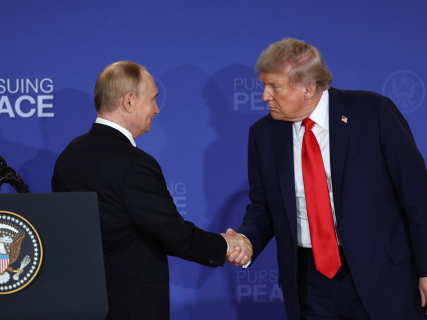
Trump announces an agreement with Putin to increase the supply of Russian diesel and curb the rise in prices

The American president assures that Russia will initially provide more than 300,000 tons of diesel and commits to new deliveries in November. The announcement comes just a few weeks before the midterm elections, with fuels being one of the main issues for the Republicans.

2 minutes

fotonoticia 20261009210623 1920

fotonoticia 20261009210623 1920

Add DEMÓCRATA to Google

Ask FREN

Published

Last updated

2 minutes

Most read

The President of the United States, Donald Trump, announced this Friday an agreement with his Russian counterpart, Vladimir Putin, to increase the supply of diesel to international markets, with the aim of reducing fuel prices amid the energy crisis resulting from the war against Iran. The pact includes several staggered deliveries of diesel, both for the U.S. market and for the rest of the world.

According to Trump, explained through his social network Truth Social, the agreement was reached after a meeting with Putin and will allow for the incorporation of more than 300,000 tons of diesel immediately, another 500,000 during November, and an additional million tons later.

The leader also pointed out that Russia could supply another three million tons of diesel in a short period, although this amount will depend on the state of Russian refineries. For now, the figures and the delivery schedule come from Trump's announcement.

The rise in diesel pressures Trump before the elections

The announcement comes just weeks before the midterm elections in the United States, in a context of growing concern over the rising costs of fuels. The war against Iran and tensions in energy supply have raised transportation costs and those of numerous economic activities.

According to data collected by El País, the price of diesel has increased by nearly 70% since the start of the bombings on Tehran and has surpassed the highs recorded during the first months of the Russian invasion of Ukraine.

This evolution has increased pressure on the U.S. Administration, especially among sectors that directly depend on fuel, such as road transport, agriculture, and livestock.

Trump promises a quick drop in fuel prices

The U.S. president has linked the agreement with Russia to the situation in the Strait of Hormuz, one of the main routes for global oil trade, and has assured that both circumstances will allow for a rapid reduction in diesel prices.

"The reduction of prices for Americans, especially for our magnificent farmers, ranchers, and truckers, is my top priority", Trump stated in his message, in which he presented the Russian commitment as a step forward to contain energy costs.

The evolution of prices will depend, however, on whether the announced quantities actually reach the market, on the production and distribution capacity of Russian refineries, and on the situation of international supply.

The announced agreement also implies a new rapprochement between Washington and Moscow in energy matters, while the war in Ukraine continues. Trump has not detailed in his communication the commercial conditions of the operations nor their fit within the restrictions applied to the Russian energy sector.

More key points, information and questions with FREN

AI-GENERATED CONTENT

At what stage of processing are the United States' energy restrictions on Russia, and what steps would be necessary to modify or lift these sanctions?

The United States' energy restrictions on Russia today form a broad framework of economic and financial sanctions affecting the production, export, financing, and technology of the Russian energy sector. They are not a "single law" in process, but a set of measures already in force, adopted in different phases since 2014 and greatly expanded after the large-scale invasion of Ukraine in February 2022. In other words, they are at a fully applicable stage, not pending approval, although subject to periodic adjustments through secondary regulations and administrative decisions.

In legal and procedural terms, the sanctions rest on three main pillars:

  • Presidential executive orders based on framework laws such as the International Emergency Economic Powers Act (IEEPA). The President declares a national emergency regarding Russia and, based on it, issues orders that limit transactions, investments, and the supply of goods and services to the energy sector.
  • Congressional laws, especially the Countering America’s Adversaries Through Sanctions Act (CAATSA) and subsequent packages linked to the war in Ukraine. These laws set mandatory or "almost mandatory" sanctions and often condition the President's ability to relax them without consulting the Legislature.
  • OFAC regulations and licenses (Office of Foreign Assets Control, Treasury Department), which detail who, what operations, and which energy products are affected, and under what exceptions or licenses certain transactions are allowed (for example, to ensure energy security or avoid abrupt market disruptions).

Therefore, the "processing status" can be summarized as follows: energy sanctions are approved and in force, with a significant degree of legal fixation by Congress and a space for technical management and adaptation in the hands of the Executive (Presidency, Treasury, State Department, and other agencies).

Steps necessary to modify or lift the sanctions

Modifying or lifting energy sanctions on Russia is not a single act, but a sequence of political and legal decisions that usually combines at least four levels:

  • Strategic political decision: the White House and the State Department assess whether conditions exist (substantive change in Russian conduct, progress in a peace agreement, verifiable commitments, etc.) to propose sanction relief. Without this fundamental decision, the other steps are not activated.
  • Review of the Congressional legal framework: when sanctions are "codified" in laws such as CAATSA or other rules passed since 2022, the President has less room to lift them alone. In these cases, the following would be necessary:
    • Either a new law from Congress that modifies, reduces, or nullifies previous sanction provisions.
    • Or the use of waiver or suspension clauses that many laws include, but which usually require:
      • Formal reports to Congress justifying that lifting or easing sanctions responds to a specific national interest.
      • Sometimes, prior consultations or notification periods before the suspension takes effect.
  • Actions by the President and the Administration:
    • The President can revoke or amend executive orders that serve as the basis for certain sanctions, reducing their scope or canceling them.
    • The Treasury Department (OFAC), along with other departments, modifies the secondary regulation: lists of sanctioned entities, types of prohibited transactions, affected energy products, price caps, etc.
    • General or specific licenses can be granted or expanded authorizing certain energy operations with Russia without needing to eliminate the entire sanction framework.
  • Congressional oversight and possible reaction:
    • Even when the Executive uses discretion margins (for example, licenses or waivers), Congress retains the ability to react:
      • Promoting critical resolutions or oversight hearings.
      • Advancing new legislation to tighten the sanction regime again if it considers the relief excessive.

In practice, partial and gradual adjustments are more common than a sudden and total lifting: exceptions for certain products or infrastructures, easing of payments or insurance, time-limited licenses, etc. This allows calibrating the international impact and conditioning relief on verifiable behavior by Russia.

As a final reminder, my main specialization is the Spanish political and institutional field. For detailed, updated, and specific monitoring of the United States' sanctions policy on Russia, including very recent measures or specific OFAC decisions, it is advisable to go directly to official U.S. sources (White House, Treasury Department, and State Department) and specialized analyses in international economic law and sanctions.

Could you explain to me what specific types of energy sanctions the United States has imposed on Russia (embargoes, price caps, technological restrictions, etc.)? How are the United States' energy sanctions coordinated with those of the European Union and other allies against Russia? What economic and geopolitical effects have the United States' energy sanctions had so far on Russia and on global energy markets?

What are the powers of the President of the United States regarding international energy agreements according to U.S. legislation?

In the U.S. constitutional system, the president has a central role in foreign policy, which includes a very broad capacity to negotiate and implement international energy agreements. However, his powers are not unlimited: they are shaped by the Constitution, numerous federal laws, and oversight by Congress and the courts.

Basic constitutional framework

The U.S. Constitution does not specifically mention energy, but it assigns the president key functions in international matters:

  • Direction of foreign policy: the president is the "Commander in Chief" and, in practice, the main person responsible for foreign relations. This gives him the initiative to propose, negotiate, and announce energy agreements with other countries.
  • Treaty-making power: Article II requires that international treaties be signed by the president and ratified with the Senate's "advice and consent" by a two-thirds majority. Formal energy treaties (for example, a large multilateral treaty on supply security) would follow this route.
  • Recognition of governments and diplomatic policy: the White House decides which governments to recognize, what type of relationship to maintain, and what priorities to set regarding energy (supply security, climate, exports, etc.).

In practice, however, most energy agreements today are not processed as formal treaties but as executive agreements and less formal arrangements.

Executive agreements and bilateral or multilateral frameworks

U.S. legislation and practice have developed several figures that allow the president to commit the country on energy matters without always going through the two-thirds Senate ratification:

  • Sole executive agreements: agreements the president enters into based on his own constitutional foreign policy powers. They can be used, for example, for energy memoranda of understanding, technological cooperation, or coordination of strategic reserves, if they do not contradict existing laws.
  • Congressional-executive agreements: international agreements approved by a simple majority in both chambers of Congress, instead of the treaty procedure. Many contemporary trade and energy frameworks (for example, agreements linked to hydrocarbon or energy goods trade) use this format.
  • Agreements pursuant to statute: when Congress passes a law expressly authorizing the president or an agency (such as the Department of Energy) to conclude international agreements on specific issues (interconnections, renewable research, reserve exchanges), the president acts supported by that legal authorization.

In all these cases, the president can negotiate and sign energy agreements, create joint working groups, coordinate supply security policies or climate cooperation, as long as he respects the limits set by Congress.

Powers derived from federal laws

Beyond the Constitution, the president's margin in energy agreements is determined by major framework laws. Some relevant categories are:

  • Control of energy exports and imports: rules on licenses to export liquefied natural gas (LNG), crude oil, sensitive technologies, or energy equipment usually grant the Executive a key role to grant, condition, or suspend flows, which translates into the capacity to negotiate supply or energy security schemes with other countries.
  • Economic emergency powers: laws such as those on economic powers in international emergencies allow the president to impose sanctions, embargoes, or financial restrictions on entities in foreign energy sectors. This is commonly used in sanction agreements and coalitions against certain producers or energy companies.
  • Management of the Strategic Petroleum Reserve and other reserves: specific legislation regulates how the president can authorize releases from strategic reserves, something often coordinated with other countries through technical agreements or political commitments in forums like the International Energy Agency.
  • Technological and climate cooperation: other laws allow the Department of Energy, the Environmental Protection Agency (EPA), or similar bodies to enter into agreements with foreign counterparts on research, energy efficiency, carbon capture, civil nuclear, etc., under the president's general supervision.

Limits and controls

Although the president has broad leeway, there are relevant checks and balances:

  • Congressional power over commerce and budget: Congress controls tariffs, broad export licenses, structural sanctions, and especially the funding of international energy programs. It can pass laws that condition or block the implementation of a presidential agreement.
  • Need for consistency with existing legislation: an executive agreement cannot contradict an existing federal law. If it did, it could be challenged in courts or Congress could react with new legislation.
  • Judicial review: federal courts can review whether the president has exceeded the powers granted by the Constitution or laws when applying or interpreting an international energy agreement.

In summary, the President of the United States can negotiate, sign, and implement a wide variety of international energy agreements relying on his foreign policy powers and numerous sectoral laws, but the validity and practical scope of those agreements depend on their fit with federal legislation and ongoing oversight by Congress and the courts.

Can you explain with concrete examples what types of energy agreements the United States has signed in recent decades? What legal differences exist between a formal energy treaty and an executive agreement in the United States? How can Congress limit or reverse an international energy agreement promoted by the U.S. president?

What was Vladimir Putin's political and professional trajectory before becoming president of Russia?

Vladimir Vladimirovich Putin was born on October 7, 1952, in Leningrad (now Saint Petersburg), into a working-class family. His childhood took place in an environment marked by the devastation left by World War II in the city. In his youth, he was interested in combat sports, especially judo and sambo, which he later presented as a school of discipline, self-control, and strategy.

After completing secondary education, Putin enrolled in the Law Faculty of Leningrad State University, where he studied from 1970 to 1975. His legal training focused on international law, a field that fit with the Soviet security services' interest in recruiting qualified young people for foreign intelligence work. In fact, during his university years, he already came into contact with the KGB, the main Soviet state security agency.

Upon graduating in 1975, Putin officially joined the KGB. His career in the security apparatus deeply marked his professional trajectory and later political style. First, he attended KGB School 401 in Leningrad and then the prestigious KGB Higher School in Moscow (the Andropov School), specialized in foreign intelligence. During this stage, he received training in espionage techniques, counterintelligence, information analysis, and clandestine operational methods.

In the late 1970s and early 1980s, he worked for the KGB in his hometown, performing counterintelligence and foreign contact control functions. In 1985, he was assigned to the German Democratic Republic, specifically Dresden, where he remained until 1990. During his stay in East Germany, Putin operated as an intelligence officer, coordinating informant networks and monitoring both local citizens and Western visitors. Although his rank was not among the highest in the service hierarchy, this stage gave him direct experience in foreign operations and in monitoring the progressive collapse of the Soviet bloc.

The collapse of the GDR regime in 1989 and, shortly after, the beginning of the USSR's disintegration had a direct impact on his career. In 1990, he returned to Leningrad and joined the State University as assistant to the rector, Anatoly Sobchak, a prominent reformist jurist who would become one of the most influential politicians in post-Soviet Russia. Putin combined this academic role with his work in the local KGB structure (soon renamed FSB), although he formally left the service in 1991.

The real turn toward institutional politics came with Sobchak's election as mayor of Saint Petersburg in 1991. Putin joined his team and held several key positions in the municipal administration, including president of the City Council's Foreign Relations Committee. From this position, he worked to attract foreign investments, establish cooperation agreements with European cities, and manage licenses and concessions related to foreign trade. This work gave him experience in economic management, international projection, and negotiation with companies and foreign authorities, as well as building his own network of political and business contacts.

During the early 1990s, Putin consolidated himself as one of Sobchak's trusted men, with a reputation as an effective and discreet manager. However, in 1996, Sobchak lost re-election as mayor, and his team left municipal power. Putin then moved to Moscow, where he began a rapid career in the federal administration, linked to President Boris Yeltsin's environment.

In Moscow, Putin first held mid-level positions in the Presidential Administration, including roles in the State Property Management Directorate. In 1997, he was appointed deputy head of the Presidential Administration and head of the Control Directorate, responsible for supervising compliance with presidential and government decisions throughout Russia. This role strengthened his image as a loyal and effective official, capable of imposing discipline in a fragmented state apparatus.

The turning point was his appointment as director of the Federal Security Service (FSB) in July 1998, the direct successor of the KGB. At the head of the FSB, Putin combined his experience in the secret services with growing political visibility. In August 1999, Yeltsin appointed him prime minister. By then, Putin's trajectory had moved from undercover work in Soviet intelligence to the pinnacle of Russian executive power, placing him on the threshold of the presidency he would assume at the end of 1999.

How did Putin's years in the KGB influence his way of governing Russia later? What role did Putin play as prime minister in 1999 before assuming the presidency? What was the political and economic context of Russia when Putin came to power in the late 1990s?

Play

Test your knowledge with FREN!

How much do you know about this topic? Answer the following 3 questions.

What is the main objective of the agreement announced between Donald Trump and Vladimir Putin regarding diesel supply?

Question 1 of 3

How much has the price of diesel increased since the start of the bombings on Tehran according to the news?

Question 2 of 3

What does the effectiveness of the agreement to reduce diesel prices depend on according to the announcement?

Question 3 of 3