The Government secures 10,000 million for loans of 50,000 euros without interest for the down payment of a first home.

The loan line will be managed by the ICO. In the previous decree-law, its allocation depended on the General Budgets. Thus, the allocation is guaranteed.

3 minutes

EuropaPress 7824171 presidente gobierno pedro sanchez rueda prensa posterior consejo ministros

EuropaPress 7824171 presidente gobierno pedro sanchez rueda prensa posterior consejo ministros

Add DEMÓCRATA to Google

Ask FREN

Published

3 minutes

Most read

The Government wants to tie up one of its main instruments to facilitate access to first housing before the electoral advance changes the course of the legislature. The program TU CASA, designed to help those who can afford a mortgage but do not have enough savings to cover the down payment, will have a allocation of 10 billion euros in loans.

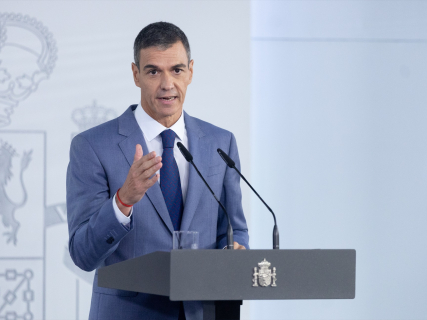
The figure, announced this Tuesday by the President of the Government, Pedro Sánchez, during his appearance after the Council of Ministers, represents the main change regarding the design that the Executive had approved just a few days earlier. The mechanism was already included in the Royal Decree-law on housing approved on September 29, but the text did not then set a specific amount to implement it.

The decree established that TU CASA would be financed from the budget of the Ministry of Housing and Urban Agenda and that the initial amount of the line would have to be developed through a subsequent agreement of the Council of Ministers. It is precisely that step that the Government now intends to accelerate, in a scenario marked by the call for general elections on November 29.

In the previous decree-law, which was overturned by the Plenary, the allocation was not specified because it was expected to be included in the General Budgets

10 billion to facilitate the down payment for housing

TU CASA is conceived as a complementary financing instrument to the bank mortgage. It will allow covering up to 20% of the value of the home, with a maximum of 50,000 euros, through a public loan at zero interest and no fees. The term for repayment will be up to ten years, while the grace period may extend until the end of the mortgage, with a maximum of 30 years.

The logic of the program is to act on one of the main obstacles for first-time homebuyers: having enough savings to face the down payment. The State would thus complement bank financing without replacing the private mortgage loan.

The design also incorporates a condition regarding the properties acquired: the homes financed through TU CASA will be permanently subject to a maximum transfer price, which must be reflected in the deed and in the Property Registry.

The Government now presents the 10.000 million as an unprecedented investment in this area. According to its calculations, the amount is equivalent to approximately three times the current budget of the Ministry of Housing and Urban Agenda and exceeds by 9.500 million the budget allocated to housing during the last Government of Mariano Rajoy.

Beyond the political comparison, the magnitude of the figure responds to a concrete decision: to guarantee the necessary credit so that the Ministry can activate the program as soon as possible, despite the fact that the Cortes have been dissolved and the legislature has entered its final stretch.

A change regarding the first decree

The movement takes on special relevance because YOUR HOUSE was already one of the measures included in the housing decree that Congress repealed last Friday. That text had formally created the mechanism, but left pending the determination of its economic endowment. The decree was repealed by Congress on October 2.

The new version maintains the basic structure of the program, but the Executive now introduces the figure of 10.000 million as financial backing for the initiative. Sánchez has defended that the new approval of the measures responds to the fact that, despite parliamentary rejection, the circumstances justifying its implementation have not changed.

The financing does not imply, in any case, a direct transfer of 10.000 million to the buyers. It is a line of loans that will be used as operations are granted. Furthermore, the mechanism itself contemplates that the resources from the reimbursements can be reused during its validity period before returning to the Treasury.

The management will correspond to the Official Credit Institute (ICO), which will administer the program through separate accounting. The next step will be to specify the requirements, beneficiaries, and access procedure through the corresponding agreement of the Council of Ministers.

Thus, the Government tries to secure one of the main bets of its housing policy before the elections on November 29 open a new political stage. The immediate objective is that the change of calendar does not also leave the resources with which it intends to facilitate the leap of first-time homebuyers from renting to ownership in the air.

More key points, information and questions with FREN

AI-GENERATED CONTENT

What is the current status of the parliamentary processing of the TU CASA program and what are the next steps for its full implementation?

As of October 6, 2026, the TU CASA program is not under active parliamentary processing nor can it be launched as originally designed. Its initial regulation was included in Royal Decree-Law 26/2026, of September 29, published in the BOE on September 30, 2026, but the Congress rejected its ratification, so the decree-law has become void and the line cannot be legally deployed nor accept applications.

What TU CASA was legally and how it was approved

The TU CASA program was configured as a public financing mechanism managed by the ICO to support the purchase of the first main residence. According to article 19 of Royal Decree-Law 26/2026 (text in the BOE), it provided for:

  • A public loan at 0 % interest and without fees, channeled through the ICO.
  • Maximum amount of up to 20 % of the appraisal value of the home and, in any case, a cap of 50,000 euros.
  • Complementary nature of private financing, to cover the part of the down payment not reached by the main bank mortgage.

Like any decree-law, TU CASA formally came into force on the day of its publication in the BOE, but conditioned on the Congress ratifying the Royal Decree-Law within the period established by the Constitution. Furthermore, article 19 itself referred to a subsequent agreement of the Council of Ministers to set allocation, access requirements, income and price limits, and application procedures; that is, without that development the program could not operate practically.

Parliamentary processing status

Royal Decree-Law 26/2026 was part of the housing decree package that the Government took to Congress in early October. According to parliamentary coverage and specialized press, on October 2, 2026 the Plenary of Congress voted on the ratification of those decrees and the majority (PP, Vox, and Junts) opposed the housing-related one, in which TU CASA was included (Demócrata report).

Since it did not pass the vote:

  • The Royal Decree-Law was not ratified and therefore ceased to be in force.
  • No subsequent processing as a bill on the same text was opened (the option sometimes agreed to allow amendments).
  • Consequently, TU CASA is not currently part of any ongoing legislative file nor in commission phase, working group, or plenary debate.

From a strictly parliamentary point of view, therefore, the initiative is considered failed in its first iteration: it completed the government phase (approval in the Council of Ministers and publication in the BOE), but failed in the parliamentary control phase by not obtaining ratification.

Next necessary steps for possible entry into force

For a mechanism equivalent to TU CASA to actually operate, two blocks of steps would be needed: one legislative and another regulatory/operational.

1. New legislative decision

Since the norm covering the program has become void, the Government should choose one of these paths:

  • Approve a new housing royal decree-law that includes the TU CASA line or a revised version of it, justifying again the extraordinary and urgent need, and submit it again to Congress ratification. Without ratification, the same would happen again.
  • Or submit to the Cortes a regular bill regulating the program, following the full procedure: admission for processing, opening of amendments, working group report, commission opinion, approval in the Plenary of Congress, passage through the Senate and, if applicable, return to Congress.

Only when one of these paths culminates in a valid law or decree-law could there be stable legal coverage for TU CASA.

2. Regulatory development and implementation

Even with a new norm in force, the program would not be automatic. At minimum, the following would be needed:

  • A specific agreement of the Council of Ministers setting the initial budget allocation, beneficiary profiles, income and housing price limits, financeable percentages, and, if applicable, grace periods.
  • The formalization of collaboration agreements with the ICO and financial entities, defining how the public loan and private mortgage combine.
  • The approval and publication of operational rules (regulatory bases, instructions, or calls) detailing the application procedure, required documentation, granting and control criteria.
  • The enabling of processing channels (electronic platforms, offices, integration with commercial banking).

Until that double leap —new legislative decision successful in the Cortes and full regulatory and operational development— the TU CASA program must be understood as an announced initiative tested in a rejected decree-law, but neither in force nor available to the public.

What are the competencies and functions of the Official Credit Institute (ICO) in managing this type of public financing instruments?

The Official Credit Institute (ICO) is a public bank attached to the Ministry of Economy, acting as the State's financial instrument to support economic activity. In managing public financing instruments (credit lines, guarantees, subsidized loans, public-private investment funds, etc.), its competencies and functions are articulated on several complementary levels.

Firstly, the ICO designs and structures financial products aligned with the economic policy priorities set by the Government: support for SMEs and self-employed, promotion of productive investment, ecological and digital transition, internationalization, innovation, or reconstruction after economic crises. Based on public objectives (resource volume, eligible sectors, project types), it defines the framework conditions of the instruments: terms, interest rates, grace periods, required guarantees, eligibility criteria, and possible interest subsidies.

A central part of its function is indirect financing through private financial entities. In the well-known “ICO Lines,” the institute signs agreements with banks and credit cooperatives that act as intermediaries: they market the loans, analyze the final client's risk, and formalize the operations, while the ICO provides wholesale funds and assumes a significant part of the credit risk. This structure allows deploying public financing with territorial reach and leveraging the commercial networks and analytical capabilities of collaborating entities, maintaining public control over the instrument's design.

In parallel, the ICO also manages direct financing in singular operations of larger size or complexity (large investment projects, infrastructures, renewable energies, innovative or business internationalization projects). In these cases, it acts as a public development bank, negotiating directly with companies or consortia, performing technical and financial project analysis, and structuring loan, co-investment, or guarantee operations that often attract additional private financing (“crowding in”).

Another key competency is managing funds or specific vehicles constituted with national or European resources (for example, venture capital funds or co-investment vehicles for startups and scaleups, infrastructure funds, or instruments linked to EU programs). The ICO can act as managing entity or as a channeling vehicle, selecting private managers, setting eligibility rules, and supervising fund deployment to ensure they meet defined public objectives.

On the technical level, the ICO assumes risk analysis, impact evaluation, and portfolio monitoring functions. Although in intermediated lines it delegates part of the analysis to banks, it establishes admissibility criteria, sector concentration limits, and compliance controls. In direct financing and specialized funds, it performs financial due diligence and, if applicable, technical and environmental assessments, evaluating economic viability, leverage effect, additionality of public financing, and compatibility with State aid regulations.

The institute also performs control and reporting functions towards the General State Administration and, when appropriate, towards European institutions. This includes monitoring budget execution of instruments, preparing periodic reports on line usage, beneficiary profiles, sectoral and territorial distribution, as well as economic impact indicators (induced investment, associated employment, contribution to green or digital objectives). This information serves to reorient or redesign instruments based on their effectiveness.

At the legal and institutional level, the ICO ensures that the public financing instruments it manages comply with the financial, budgetary, and public aid regulatory framework (Spanish and European). It cooperates closely with competent ministries in economy, treasury, industry, ecological transition, or others, which set the broad public policy lines, while the institute translates those objectives into operational financial products manageable from a risk perspective.

Finally, the ICO plays a technical advisory role to the public sector. Thanks to its financial experience and market knowledge, it can propose new instruments or adjustments to existing ones to the Government, detect market failures in financing certain groups or sectors, and suggest more efficient public-private collaboration mechanisms. Thus, it not only executes public financing policy but actively contributes to shaping it.

Could you detail how ICO Lines operate operationally through commercial banking? What role does the ICO play in managing European funds and how are those instruments coordinated with Spanish economic policy? What are the main differences between ICO's direct financing and intermediated financing to companies and projects?

What legal requirements and conditions must beneficiaries meet to access loans from the TU CASA program according to current regulations?

According to information available as of October 6, 2026, the “TU CASA” loan program is regulated in the Royal Decree-Law on urgent housing measures approved on September 29, 2026, and published in the BOE on September 30, 2026. That norm creates the mechanism and sets its basic conditions, but refers much of the access requirements to a subsequent development (regulation, Council of Ministers agreement, and agreements with the ICO and financial entities). This is key to interpreting which demands are already finalized and which are not.

1. Purpose of the program and basic beneficiary profile
  • Loan purpose: to finance part of the purchase of the first main residence of the beneficiary, provided the acquisition is made through a private mortgage loan. Its use for second homes or investment is not allowed.
  • Essential condition: the norm requires that it be the purchase of the first mortgaged main residence. This is, as of today, the only clearly defined personal requirement in the basic text, beyond the capacity to obtain the main mortgage.
  • Age limit: the housing decree does not set any age limit. The Ministry of Housing itself has highlighted that “TU CASA” is open “to the entire population, without age requirements.”
  • Management: the line will be managed by the Official Credit Institute (ICO), charged to the Ministry of Housing and Urban Agenda budget.
2. Financial conditions of the TU CASA loan
  • Maximum amount: the State can contribute the lesser of these two amounts:
    • 20 % of the value of the home (in terms of sale or appraisal, as specified in the regulatory development), and
    • 50,000 euros.
  • Interest and fees: the loan is granted at 0 % interest and without any fees.
  • Repayment term: up to 10 years to repay the capital to the State.
  • Grace period: a grace period is foreseen during which the beneficiary does not start repaying the public loan. This grace will generally be equivalent to the term of the private mortgage, with a maximum of 30 years. The specific configuration (how and when payments start) must still be detailed in subsequent norms.
3. Conditions on the acquired home
  • Use as main residence: the home must be intended as the buyer’s main residence. This allocation is inherent to the line, although details (minimum occupancy period, justified reasons to rent or change home, etc.) will be specified by regulation.
  • Permanent price cap: the main counterpart of the program is that the home purchased with TU CASA financing is subject permanently to a maximum resale price:
    • on a second sale and subsequent ones, the price cannot exceed the purchase price updated by the CPI;
    • certain investments in rehabilitation or improvement may be added, under terms set by the regulation.
  • Registry publicity: this limitation is incorporated into the public deed and registered in the Property Registry, so it “follows” the property regardless of the owner.
4. Income, assets, maximum price, residence, etc. requirements

Although possible income or home price limits have been mentioned in public debate, the joint analysis of the Royal Decree-Law and the most recent official and press documentation indicates that, as of today:

  • They are not yet set in the basic norm:
    • a concrete income limit expressed in multiples of the IPREM or other reference;
    • a general asset limit for the applicant;
    • a maximum acquisition price applicable nationwide;
    • prior residence or registration requirements (years in the municipality or community);
    • detailed criteria on employment status or required contract types.
  • The decree itself expressly refers to a subsequent Council of Ministers agreement and other normative instruments to specify:
    • the detailed object of the financing,
    • the beneficiary profile,
    • the limits and access characteristics, and
    • the application and resolution procedure.
5. Difference from other housing programs

It is advisable not to confuse TU CASA with other state or regional lines:

  • The ICO guarantee line for young people and families (regulated by a prior ministerial order) does set income limits (around 4.5 times the IPREM), maximum net assets, and continuous residence requirements, but it is a different program.
  • Many regional programs of guarantees or purchase aids (such as “Mi Primera Vivienda,” “Gazteaval,” etc.) include age caps, maximum home prices, and registration requirements, which are not part, as of today, of the core state TU CASA.
6. Summary

In the current regulation, the already clear requirements to access TU CASA are: that the loan is destined to the purchase of the first mortgaged main residence, that the permanent resale price limitation is accepted, and that the operation is formalized with a private mortgage complemented by the public loan of up to 20 % of the value and 50,000 euros, at 0 % interest and without fees, with a maximum term of 10 years and grace linked to the mortgage (up to 30 years). The other parameters (income, assets, maximum price, residence, procedure) are pending regulatory development; until those development norms are approved, all access conditions for beneficiaries cannot be precisely known.

Could you detail exactly how the resale price limitation works for a home purchased with the TU CASA loan? How does the TU CASA program differ, in terms of requirements and effects, from the ICO guarantee line for young people and families? What leeway do autonomous communities have to add their own requirements (income, registration, maximum price) to the application of the TU CASA program in their territory?

Play

Test your knowledge with FREN!

How much do you know about this topic? Answer the following 3 questions.

What percentage of the value of the house will the TU CASA program loan cover at most?

Question 1 of 3

Which entity will be responsible for managing the TU CASA program?

Question 2 of 3

What is the maximum term to repay the loan granted by the TU CASA program?

Question 3 of 3