

There is an idea that is repeated in discussions and offices that does not fit reality: the supposed rightward shift of Spanish society. The data says otherwise and the symptom is being confused with the disease. They leave a clear photograph: In the midst of a climate of political harassment and with the natural wear of governing, the PSOE maintains its electorate around 27%. The reason why the sum of PP and Vox today brushes against an absolute majority is not a conservative tide in the streets, but rather that the space to the left of the PSOE is in free fall and without brakes.
Podemos and Sumar, or ‘Frente Amplio’ (no matter how misguided I think the name is), are moving at 2.7% and 5.6% in voting intention. If the general elections were tomorrow, their representation would be reduced to a sad seven deputies (five for the Sumar platform and two for Podemos), sending hundreds of thousands of progressive voters to abstention due to disaffection or pure weariness.
The reason why the sum of PP and Vox today brushes against an absolute majority is not a conservative tide in the streets, but rather that the space to the left of the PSOE is in free fall and without brakes
People are watching us and, simply, do not understand us. Those who vote on the left do not understand the trench fights, do not understand that there is more talk of names than of real problems, and do not understand that we behave as if we had time to waste. We cannot disappoint the citizens because what is at stake is the future of the country and the daily life of millions of people. It is time to rise to the occasion, stop looking at our belly buttons, and listen to what society expects from its representatives.
Spain is not right-wing
It is worth remembering the data to disarm the defeatism that paralyzes our electorate. In almost fifty years of democracy, the right has only achieved an absolute majority in Congress on two occasions out of 16 general elections:
- In the year 2000, with José María Aznar in the midst of a pre-euro boom cycle.
- In November 2011, when Mariano Rajoy benefited from the social impact of the 2008 financial crisis.
In the other fourteen calls, they did not reach an absolute majority. And the only two times they achieved it was in the heat of the economic situation. With the economy in their favor, Aznar was revalidated with an absolute majority, and with the economy against him, Zapatero fell and Rajoy achieved an absolute majority.
Today the country is growing above the average of the European Union and we have record employment figures. The economy is in favor. Therefore, if the right has real options today to return to power, it is time to assume the responsibility for our organic decomposition and our own inability to coordinate and convince that we are a useful alternative.
Pedro Sánchez and the mistake of repeating 2014
A good part of the leaders of the alternative left continues to think with the coordinates of twelve years ago. In 2014, a PSOE bewildered by austerity policies left an immense void that Podemos capitalized on. Today that scenario does not exist.
Pedro Sánchez heads a cohesive party and has demonstrated strong leadership and knows how to occupy the ground of his left. Every time this space proposes a social advance, the president makes it his own or pushes it forward from the Council of Ministers and takes on the leading role. The left sets the agenda, but trying to compete with him by seeing who is "more leftist" no longer works; there is no space there. Insisting on that path only leads to the testimonial marginality of 5% or 6% of the votes, which is the historical floor of Izquierda Unida in the 90s when the PSOE governed firmly.
If it makes no sense to seek differentiation in ideological purity against the PSOE, because it occupies the left and center-left facing the voters, where is the space that the socialists do not cover? The answer lies in the territory.
The strength of territorial organizations
The PSOE has a centralist and state culture that struggles to connect with local sensitivities. Thus, if the PSOE has eaten up the space to its left, it has left a huge gap in the territorial aspect. And it is there where organizations with their own roots are essential.
In their respective territories, the BNG in Galicia, EH Bildu in Euskadi, Compromís in the Valencian Community, or the Chunta Aragonesista in Aragón have solid support and growing social credibility. These formations have supported the government's agenda of social advances seriously, but without diluting their identity or allowing themselves to be absorbed by the PSOE. They have not shared government, and their voters see them as useful tools for their communities. Their prospects in the polls are optimistic. Furthermore, they have managed to find successful ways to cooperate both in parliamentary support and in electoral arithmetic, where the example of Ahora Repúblicas in the European elections (ERC, Bildu, and BNG) showed that the technical sum of ballots allowed maximizing seats without anyone losing their voice.
For its part, Más Madrid has consolidated itself as a reference in the Community of Madrid, reaching nearly 20% in the previous regional elections and demonstrating a metropolitan rooting that the PSOE did not achieve. Más Madrid and Comuns have territorial roots to lead their constituencies, although these formations do not show growth in the polls because they could suffer from the wear of the government and the closeness to the PSOE in the coalition.
But when it comes to seeking the electoral agreement, we must learn from the mistake made by Sumar when it tried to create a new and parallel organization in each of the territories where it already had a coalition partner. This undermined the leadership of Yolanda Díaz, who has probably been the best Minister of Labor in democracy, but did not understand that leadership is cultivated by helping others grow around you and not by eliminating or competing with your own.
How the alliance is articulated
If we start from the premise that the strong space for electoral competition is anchored to the territorial, the responsibility of the forces of the transformative left is to find that territorial fit that achieves utility from strategic realism and that their proposal is capable of explaining to voters what their contribution to a new progressive majority is.
The responsibility of the forces of the transformative left is to find that territorial fit that achieves utility from strategic realism
For this, a lot of generosity will be needed and to approach unity from a functional perspective. We must set aside unity for the convenience of some actor or unity as a fetish and explain to progressive citizens where and how it is useful to unite and where it is not.
Clearly, in the territories where there is a strong left-wing force with deep roots and good electoral prospects, the objective should be clear: support that political force so that it achieves the maximum possible seats. I will give the example of Compromís, where it has unquestionable leadership in the País Valencià and the rest of the forces must stand behind to support. There are more complicated territories, and here the example of Galicia or Euskadi is relevant, where the leadership is of a force outside of Sumar and they do not have prospects of winning a seat. In these territories, the most strategic option might be to support the candidacies of the BNG or Bildu from the outside or, without supporting, make the decision not to compete and explore other types of agreements in local spaces, the Senate, or other alternatives.
Leaving behind the entanglements and opening the decisions
The preparation of the lists can derail due to two endemic problems: the obsession with Madrid and the oligarchic dynamics of the party leaderships.
There is much talk in leftist spaces about plurinationality and federalism, but when push comes to shove, it is still assumed that the head of the list must necessarily go through Madrid to be "the candidate for the presidency." It is a mistake. In Spain, we have a parliamentary monarchy and we vote for deputies in fifty provinces, not for a president. And let's be honest: in this political cycle, the candidate for president of the progressive bloc is Pedro Sánchez.
Whoever leads the space to his left is not going to preside over the Government; their role is to head a strong parliamentary group that conditions the legislative program and pushes social measures with their strength in Congress. In practice, in the electoral campaign, the person chosen as a state reference has a specific function: to represent us in the television debates of the campaign. And to go on television, it is not necessary to be registered in Madrid nor to set up strange swaps like exchanging candidacies between Madrid and Barcelona. Today, one can lead a state campaign with total solvency from Valencia, Barcelona, Zaragoza, or A Coruña.
To organize this with common sense, two elementary steps are needed:
- That those who are playing for their position do not negotiate the lists: The agreement tables cannot be made up of those who aspire to their own seat. It is human for personal interest to weigh in, but it cannot condition the fate of an entire political space. Those who have nothing at stake must negotiate with a clear and legitimized mandate from the entire organization.
- Democracy from the bottom up: Decisions must be opened to the people through censuses of registered individuals so that each constituency decides its candidates.
The Congress and the Senate: a complete strategy
The electoral architecture in Congress and the Senate consists of a series of rules that must be known to make the most of electoral gains within the system. In small provinces in the interior (with three to five deputies), obtaining a seat requires getting more than 15% or 20% of the votes. Presenting testimonial candidacies in Cuenca, Ávila, or Zamora only serves to throw ballots in the trash and give deputies to the PP or Vox. In those places, common sense dictates supporting territorial forces if they exist, or reaching agreements with the PSOE not to run and concentrate the vote.
Now, that tactical withdrawal in Congress only makes sense if it is linked to a unitary list for the Senate. With strategic arithmetic for each constituency, the result can be optimized and more political forces can be added from their autonomy.
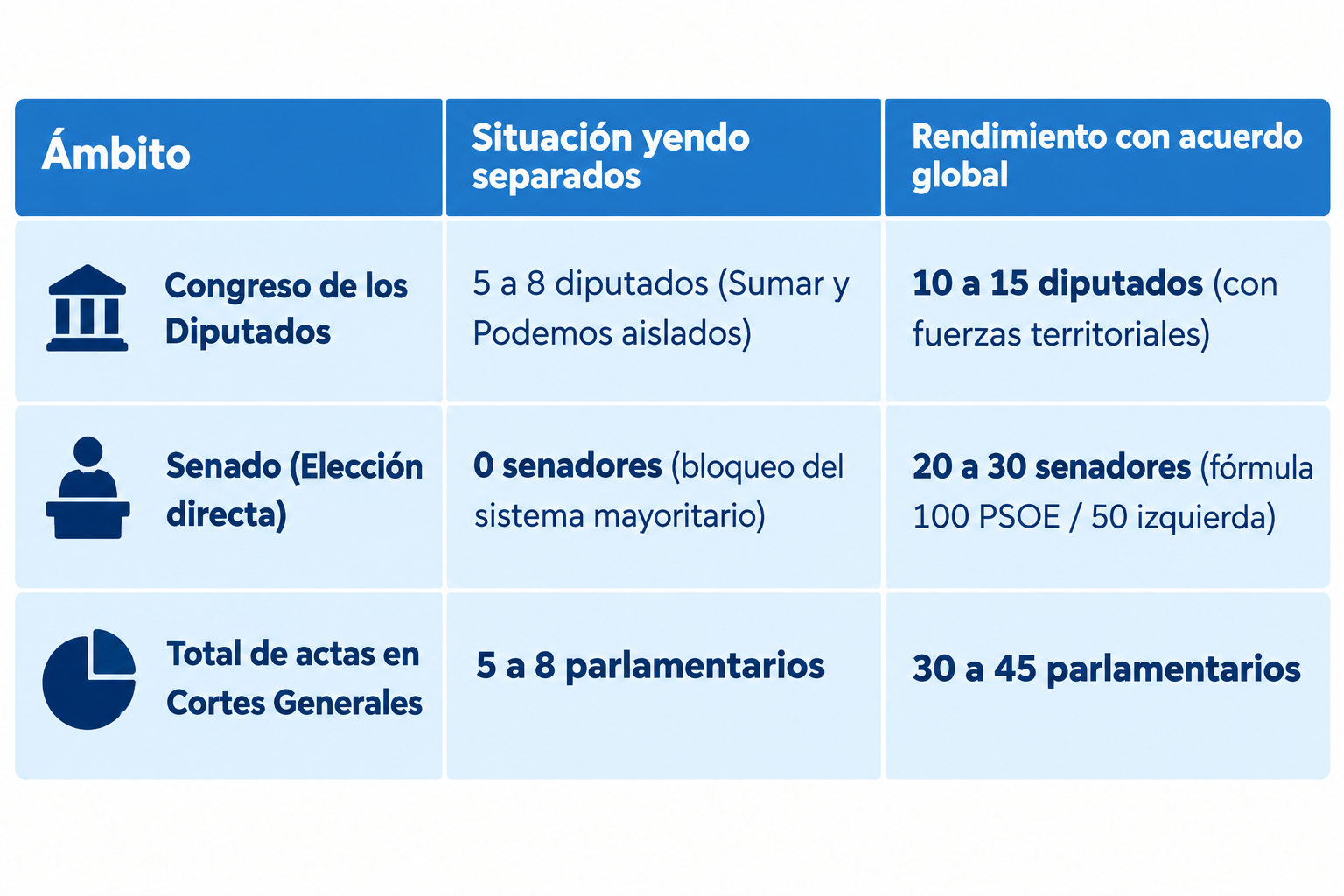
The qualitative leap can transform the result and achieve a progressive majority:
- Achieve positions where the vote does not reach: In a province where the alternative left does not reach the minimum to obtain a deputy, an agreement with the PSOE for the Senate allows our candidate to be elected senator within the joint list of three names.
- Change the scale of negotiation: Instead of self-destructing in bureaucratic disputes over seven or eight precarious seats in Congress, let’s negotiate a global presence of between 30 and 45 parliamentarians in the Cortes Generales. This arrangement allows less territorial forces like Podemos or IU to achieve their representation.
- Effective institutional control: With more than twenty of our own senators, this space would have an important parliamentary group, with a reference spokesperson in the Upper House and the key to renewing the Constitutional Court and the General Council of the Judiciary, preventing the PP from using the Senate as a blocking trench and ensuring visibility in territorial politics.
Let us act responsibly
The transformative left, if it wants to be worthy of such a qualification, cannot continue to look at its navel towards the electoral debacle while the right and the far-right prepare their arrival at La Moncloa. Progressive society is watching us with concern and has more than enough reasons to be disenchanted. We cannot fail them.
We must act with electoral intelligence and political generosity, because they will not forgive us if a real sociological majority is not represented by the incapacity of its leaders to find a viable roadmap.
The way out exists and is within reach: support the living forces in each territory, not waste votes in Congress, and close a joint list with the PSOE for the Senate. Stopping fighting for crumbs to move towards building a parliamentary force of forty seats is not renouncing anything: it is political maturity, institutional responsibility, and the only real way to protect the rights of ordinary people.