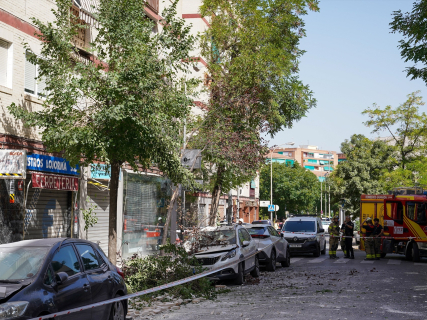

The earthquake of magnitude 4.8 registered this Tuesday near Gójar and the successive aftershocks have left cracks, landslides, and damages in homes and buildings of different municipalities in Granada. Owners, community members, and businesses that have suffered damages can request compensation, but they must meet one fundamental condition: to have a valid insurance policy when the earthquake occurred.
The agency responsible for covering these incidents is the Consorcio de Compensación de Seguros, a public entity that covers the so-called extraordinary risks.
Who pays for the damages caused by an earthquake
Earthquakes are expressly included among the natural phenomena in the Reglamento del seguro de riesgos extraordinarios.
This means that when the earthquake causes damage to insured property, the compensation corresponds to the Consorcio de Compensación de Seguros. The coverage is financed through a surcharge included in the policies of the affected branches.
It is not necessary to have contracted specific earthquake insurance, but it is necessary to have a valid policy that protects the home, the building, the vehicle, the business, or another affected asset.
It is also not necessary to wait for the area to receive an administrative declaration of emergency or "catastrophic zone" to report the incident. The coverage responds to the existence of the phenomenon, the damages produced, and the fulfillment of the insurance requirements.
What requirements must be met to collect compensation
The Consorcio requires that the damaged property was protected by a policy in force at the time of the earthquake and with the corresponding receipt paid.
The coverage may come, among others, from home insurance, homeowners associations, offices, businesses, workshops, industries, vehicles, and certain accident or life policies.
The compensation is adjusted to the goods and capital included in the contract. Therefore, if the policy only covers the structure of a home, it does not automatically protect the furniture, appliances, or other items inside.
The structure includes the constructive elements of the property, while the content generally refers to the insured belongings. The amount will also depend on the limits established in each policy and the valuation of the appraiser.
What earthquake damages are covered by the Consorcio
The coverage may include direct damages caused by the earthquake in:
- Homes and buildings: cracks, structural damage, breakage of doors, windows, floors or walls.
- Common elements of homeowners' associations, such as facades, roofs, stairs, entrances or installations.
- Furniture, appliances and other belongings, as long as the content is insured.
- Shops, offices, workshops and industrial facilities.
- Vehicles affected by debris, falls of construction elements or other damage linked to the earthquake.
- Necessary expenses for demolition, debris removal and waste transport, under the terms provided in the regulations.
- Death, disability or temporary incapacity when there is a life or accident policy that allows activating this protection.
In businesses, loss of profits can also be claimed, but only if that coverage was expressly included in the policy and the interruption of activity results from direct damage to the insured goods.
It is not enough to prove that the earthquake was felt in a locality. The expert must determine the relationship between the earthquake and the claimed damages, as well as distinguish them from possible prior damages.
Does the Consortium cover a car insured for third parties?
Yes. The Consortium indicates in its official compensation claim guide that damages caused by extraordinary risks can be compensated both in vehicles with comprehensive insurance and in those that only have a liability policy.
Therefore, a car insured for third parties can also receive compensation if it is damaged by the earthquake, as long as the insurance was in force when the incident occurred.
This circumstance is particularly relevant for vehicles affected by debris, falls of facades or elements that have fallen onto the roadway.
How to claim earthquake damages from the Consortium
The application can be submitted directly by the insured, the policyholder, a representative, the insurance company or the agent or broker who managed the insurance.
There are two main ways:
- By phone: calling 900 222 665, Monday to Friday, between 09:00 and 18:00 hours.
- Online: through the official compensation claim page of the Insurance Compensation Consortium.
Although the payment corresponds to the Consortium, the affected party can also contact their insurer or their mediator to help them gather the documentation and process the file.
When registering the request, a reference number is assigned, necessary to subsequently check the status of the claim.
What documentation needs to be submitted
To initiate the file, it is advisable to have the following data prepared:
- Name of the insurer and policy number.
- Name, surname, and ID number of the insured and, if applicable, of the person presenting the claim.
- Address of the property or identification of the damaged asset.
- Phone number and other contact details.
- Bank account number IBAN.
- Description of the damages.
- Photographs of the damages.
- Receipt proving the payment of the insurance.
- Estimates or repair invoices, if they already exist.
- Brand, model, and license plate, when the claim corresponds to a vehicle.
If the car is in a workshop, it is also advisable to provide its name, address, and phone number to expedite the assessment.
The Consortium states that the compensation is paid directly to the beneficiary and by bank transfer.
How much time there is to claim: the seven days are not a definitive limit
The Insurance Contract Law establishes, in general terms, that the incident must be reported within seven days from when it is known, unless the policy specifies a longer period.
However, this does not mean that a request submitted after the seventh day is automatically rejected.
The agency itself clarifies in its frequently asked questions about claim deadlines that it recommends reporting the damages as soon as possible, preferably within those seven days, but also accepts requests submitted afterwards.
The recommendation, in any case, is to open the file as soon as possible to facilitate the assessment of the damages and expedite the processing.
The other seven-day rule: when a new insurance starts to cover
The period for reporting the incident should not be confused with the waiting period applicable to certain new policies.
The article 8 of the Regulation of extraordinary risks insurance establishes that, in general terms, the material damages caused by natural phenomena are not covered if the insurance was issued or came into effect less than seven calendar days before the incident.
This waiting period does not apply, among other cases, when a policy replaces another without interruption of coverage. It also does not apply to personal insurance.
Consequently, contracting insurance after the earthquake does not allow claiming damages that had already occurred.
Is there a deductible in compensations?
The answer depends on the type of affected asset.
According to the official information from the Consortium about deductibles, no deductible applies to damages in homes, communities of owners, vehicles, or personal insurance.
In other insured assets, such as certain businesses or corporate facilities, a general deductible of 7% of the compensable damages applies.
When claiming a loss of profits, the deductible is the one specified in the ordinary policy.