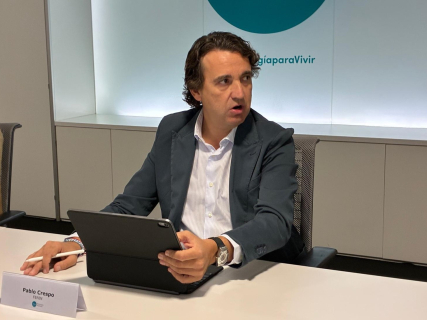
Fenin proposes four measures to strengthen health technology: public procurement by value, competitive industry, strategic autonomy, and less VAT.

Requests that at least 50% of the award criteria for public contracts be linked to quality and innovation.

Imagen 2 Pablo Crespo (1)

Imagen 2 Pablo Crespo (1)

Add DEMÓCRATA to Google

Ask FREN

Published

Last updated

6 minutes

Most read

The Spanish Federation of Health Technology Companies (Fenin) wants health technology to occupy a central place in the programs of political parties and in the priorities of the next Government. Its Secretary General, Pablo Crespo, presented this morning at a press conference four proposals to improve the quality and sustainability of the healthcare system, strengthen the competitiveness of the industry, and prevent taxation from becoming a barrier for patients.

The initiative, as he recalled, “comes at a time of political uncertainty, with pending regulatory projects and growing care challenges, such as the aging population, chronicity, waiting lists, and difficulties in accessing healthcare.” In this scenario, Crespo argued that the incorporation of technological innovation, greater exploitation of health data, and digital transformation are necessary elements to improve health outcomes.

“Healthcare is a priority. One of the keys to the welfare state is health,” emphasized the representative of Fenin, who acknowledged the work done by both the Government and the autonomous communities to modernize the technological park and facilitate access to innovation. However, he believes that there is still a long way to go and that it is necessary to advance more quickly.

The four proposals from Fenin

The first measure involves promoting a public procurement based on value, where price is not the determining factor. Thus, it is proposed to modify the Public Sector Contracts Law so that at least 50% of the award criteria are linked to quality and the incorporation of innovation. Crespo pointed out that the draft law on medicines and health products, which was under processing, proposed to limit the weight of economic criteria to 20%, a direction that, in his opinion, would allow for progress towards a contracting process that takes more into account the clinical and care value of technology.

The second proposal seeks to guarantee the competitiveness and viability of the health technology industry. To this end, the federation demands the recovery of indexing mechanisms for public contracts, currently unindexed since 2015, so that companies can face the increase in production costs without compromising their investments, employment, or the ability to supply technology to the health system. It also proposes to develop a specific plan for the sector, called Plan Protec, that recognizes the business effort in research and development, the installation of manufacturing plants, and environmental transition.

The third initiative focuses on strategic autonomy and industrialization: Fenin insists that Spain maintains a negative trade balance in health technology and depends on international markets to supply essential products. Therefore, it proposes a government plan that attracts investments, favors the establishment of production, distribution, and research centers, and expands national industrial and logistical capacities.

Finally, the fourth measure proposes to reduce the taxation of health products. According to Crespo, 85% is taxed at the general VAT rate of 21%, despite being products that he considers essential. The employers' association calls for a reduction of this tax to facilitate the incorporation of technology into the public system and reduce the costs faced by patients in the private sector. Crespo has estimated that the public health system pays more than 1.3 billion euros annually in VAT, resources that, in his opinion, could be allocated to investment and innovation if the tax burden were reduced.

A sector with health and economic impact

Fenin justifies these proposals by the role that health technology plays both in patient care and in the economy. According to the data presented by Crespo, the sector generates 12.6 billion euros of direct gross added value. Another relevant fact is that every euro invested in it produces another 1.27 euros in the Spanish economy. Furthermore, companies allocate around 7% of their turnover to innovation, leading compared to other industrial sectors.

The industry supplies technologies for the diagnosis, monitoring, and treatment of patients, present in hospitals and other assistive devices. For Fenin, its capacity for innovation can contribute to responding to the challenges of a system that must cater to an increasingly large and aging population. Crespo has recalled that Spain is approaching 50 million inhabitants and that one in five people is already over 65 years old, an age group that requires a higher consumption of health resources.

The federation also highlights the social dimension of the sector: 46% of the employment it generates is female and 3% corresponds to people with disabilities. From its point of view, these indicators reinforce the argument that health technology should not be approached solely as an expense, but also as a source of economic activity, employment, and capacity for care response.

Competitiveness, however, is conditioned by the international context. Crespo has pointed out the difficulties in supply chains, restrictions on access to raw materials, and the rising costs of energy and production. In that scenario, he considers that maintaining public contracts without updating mechanisms may hinder investment and the ability of Spanish companies to compete in other markets.

In relation to indexing, the Secretary General of Fenin has pointed out that countries like Italy, France, and Germany have mechanisms that allow for the updating of public contracts. The federation believes that these formulas favor competition and contribute to attracting technology. It does not propose, therefore, to copy a single European model, but to identify the practices that best fit the characteristics of the Spanish system.

The organization also demands that the health technology industry receive specific treatment in industrial policy. Crespo has argued that the sector has different needs from those of the pharmaceutical industry, both due to its manufacturing processes and its value chain and the characteristics of its products. Therefore, he considers it essential that this differentiation is maintained in future regulation.

The pending questions: political balance, legislation, and relationship with patients

On the balance of the last legislature, Crespo has valued the work of the Ministry of Health and the autonomous communities to modernize the technological park and improve access to innovation. He has also acknowledged the Ministry's willingness to listen to the sector's proposals. However, he has lamented that some positive regulatory projects have not been approved and has requested that they be resumed in the next political stage.

Among the pending priorities, he has cited the necessary legislative changes to favor investment and take advantage of the potential of technologies such as digital health, artificial intelligence, and robotics. In particular, he has argued that the industry bill should recognize health technology as a strategic sector. He has also demanded that the draft royal decree on the advertising of health products move forward, which, as he explained, would improve the way companies promote their technologies.

When asked about the possibility that government changes might slow these advances, Crespo has pointed out that reforms are necessary regardless of who assumes political responsibilities. In his view, those who direct health policy must know the sector, listen to its representatives, and understand the contribution of all actors involved in the system.

Regarding the relationship between the industry, healthcare professionals, and patients, he has advocated for collaboration among the organizations that represent each group. Fenin, he explained, seeks to listen to their needs and develop solutions that help solve clinical problems and improve care. Nevertheless, he has emphasized that each group must represent its own interests independently and with institutional respect, even though they all share the goal of providing higher quality healthcare.

Crespo has also argued that the regulation of health products should continue to be differentiated from that of medicines. Although both sectors contribute to improving health, he has pointed out that their manufacturing processes, value chains, and characteristics are different. As an example, he noted that health technologies do not have generic equivalents in the same terms as certain medicines. Therefore, he believes that applying differentiated regulatory approaches allows for better leveraging the potential of both industries.


More key points, information and questions with FREN

AI-GENERATED CONTENT

At what parliamentary stage is the bill on medicines and medical devices in Spain?

The Bill on Medicines and Medical Devices is no longer under parliamentary processing: the initiative has expired in the Congress of Deputies as a result of the dissolution of the Cortes and the calling of general elections. Its last effective stage was the amendment phase in the Health Commission of the Congress, processed by urgent procedure and with full legislative competence of said commission.

Project Identification

  • Short title: On medicines and medical devices.
  • Origin chamber: Congress of Deputies.
  • Type: Bill (Government initiative).
  • File number: 121/000109 (15th Legislature).
  • Official Congress record: the processing details can be consulted on the Congress website, identifying file 121/000109 in the list of bills.

Previous progress until expiration

According to official records, the Government approved the Bill on Medicines and Medical Devices in second reading at the Council of Ministers on July 21, 2026, sending it to the Cortes Generales for processing. That agreement can be seen in the official Moncloa reference about the Council of Ministers of that day (Council of Ministers reference).

In the Congress, the main milestones were:

  • Registration of the initiative: July 24, 2026.
  • Publication of the bill text: September 11, 2026 in the Official Bulletin of the Cortes Generales, Series A, no. 110-1 (BOCG A-110-1), where the full text sent by the Government appears.
  • Assignment to the Health Commission with full legislative competence, so the Commission could approve the text on behalf of the Plenary of the Congress.
  • Opening of the deadline for amendments to the articles, initially until September 29, 2026, with several subsequent extensions.
  • Urgent processing: on October 2, 2026 it was agreed that the bill would be processed by urgent procedure, shortening the deadlines of the different phases. That agreement is reflected in the subsequent publication of the Official Bulletin of the Cortes, Series A, no. 110-2 (BOCG A-110-2).

Until that moment, the bill had not passed to working group, nor had a working group report or a Health Commission opinion been prepared, and it had not reached the Plenary of the Congress nor, therefore, the Senate. The processing was still concentrated in the amendment phase to the articles within the Congress.

Dissolution of the Cortes and expiration of the bill

The determining element for the current status of the initiative is Royal Decree 806/2026, of October 5, which dissolves the Congress of Deputies and the Senate and calls general elections for November 29, 2026. That decree was published in the Official State Gazette (BOE-A-2026-20742).

The processing information of file 121/000109 expressly states that:

  • The bill was in the amendment phase in the Health Commission, with urgency and full legislative competence.
  • On October 6, 2026, once the dissolution of the Chambers was agreed, the file is recorded as closed due to expiration, that is, it lapses at the end of the legislature without having been approved.

Expiration means that the bill does not advance to further phases (working group, opinion, Plenary of the Congress, referral to the Senate, possible return to the Congress, and enactment). For such regulation to be processed again, it will be necessary that, in the new legislature, the Government decides to register a new bill or promote another equivalent initiative; the previous text, as well as the political and technical work carried out (draft bill, reports, contributions in public hearing, and possible amendments) may serve as a basis, but the same file 121/000109 is not automatically reopened.

Summary answer

Therefore, as of today, the Bill on Medicines and Medical Devices (file 121/000109) is not in any active phase of parliamentary processing. Its last stage was the amendment phase in the Health Commission of the Congress, by urgent procedure and with full legislative competence, but the dissolution of the Cortes in October 2026 caused the expiration of the bill and the end of its processing in the 15th Legislature.

Could you explain exactly what this bill on medicines and medical devices implied for the pharmaceutical and health technology industry? What steps would the new Government have to take if it wanted to resume this reform of medicines legislation in the next legislature? What other parliamentary initiatives related to medicines or medical devices are currently active in the Congress or Senate?

What are the powers and functions of the Ministry of Health regarding the regulation of health technology?

The Ministry of Health plays a central role in the regulation of health technology in Spain, combining functions of normative design, evaluation, financing, digital health, and coordination with the AEMPS, autonomous communities, and the European Union.

1. General framework of powers

Royal Decree 718/2024, on the organizational structure of the Ministry of Health, establishes that the department is responsible for the proposal and execution of Government policy on health matters and the exercise of state powers to guarantee the right to health protection (art. 1). On this basis, the regulation of health technology is mainly divided among:

  • The State Secretariat for Health, which promotes innovation, digital health, pharmaceutical policy, and interterritorial coordination (art. 2).
  • The General Secretariat for Digital Health, Information and Innovation and the Directorate General for Digital Health and Information Systems, responsible for the digital transformation of the National Health System (SNS), interoperability, and health data (arts. 3 and 8).
  • The Directorate General for the Common Portfolio of SNS Services and Pharmacy, which develops and updates the common portfolio of services and manages financing and pricing of medicines and medical devices (art. 5).

Law 16/2003, on cohesion and quality of the SNS, completes this framework by assigning the Ministry a decisive role in the definition and updating of the common portfolio and in the evaluation of new health techniques and technologies (arts. 20 and 21), as well as in the governance of the health information system (arts. 53 and 54).

2. Regulation and evaluation of health technologies

The specific axis is Royal Decree 415/2026, of May 27, regulating the evaluation of health technologies. According to its preamble and content:

  • It defines health technology assessment (HTA) as a scientific process to inform decisions on incorporation, financing, pricing, reimbursement, modification of use, or disinvestment of technologies (including medicines, medical devices, in vitro diagnostics, digital products, clinical procedures, and organizational models).
  • It organizes an HTA System with three pillars:
    • Governance Council (HTA Council), attached to the State Secretariat for Health, which sets strategy, approves technical guidelines, and ensures coherence with pharmaceutical and benefits policy.
    • Medicines Evaluation Office, as a functional unit within the AEMPS, for pharmacological technologies.
    • Non-Pharmacological Health Technologies Office, assumed by the Spanish Network of Health Technology Assessment Agencies (RedETS), for medical devices, procedures, digital therapies, etc.
  • It provides maximum deadlines (generally 90+90 days for medicines and 180 days for non-pharmacological technologies) and strengthens independence, transparency, and participation of patients and professionals.

In line with Law 16/2003, the Ministry directs and coordinates RedETS and uses its reports to propose inclusion or exclusion of techniques and technologies in the common portfolio, or their prior supervised use (art. 21).

3. Medical devices and relationship with AEMPS

The consolidated text of the Law on guarantees and rational use of medicines and medical devices (Royal Legislative Decree 1/2015) assigns the State and, in practice, the Ministry of Health, broad powers over medical devices:

  • To develop regulations on the conditions and requirements for manufacturing, import, distribution, marketing, clinical research, dispensing, and use of medical devices (including cosmetics and personal care products) in accordance with EU regulations.
  • To guarantee, through the AEMPS, authorization, inspection, market surveillance, withdrawal, and safety measures, as well as information to professionals and the public.
  • To manage, from the Directorate General of the Common Portfolio, the financing and pricing of medical devices dispensed by prescription, coding (national code), and control of advertising and promotional information.

The AEMPS, as an agency attached to the Ministry, acts as the competent authority for the application in Spain of the EU Regulations on medical devices and in vitro diagnostics and coordinates surveillance and inspection with the autonomous communities.

4. Digital health, electronic health records, and data

Royal Decree 718/2024 details very specific functions in digital health:

  • The General Secretariat for Digital Health assumes management of clinical and administrative information, identification of the protected population, governance of health data (Health Data Office), and representation of the Ministry in national and international digital health forums (art. 3).
  • It is responsible for the functional management of common services of interoperability of Digital Health Records and Electronic Prescriptions, as well as the state registry of health centers, services, and establishments.
  • The Directorate General for Digital Health and Information Systems designs and deploys public digital health services, promotes adoption of emerging technologies (including artificial intelligence), defines data strategy, ensures interoperability and data quality, and manages health ICT infrastructures (art. 8 and seventh additional provision).

All this is articulated within the framework of Law 16/2003 on the health information system and SNS communications network, where the Ministry sets common standards for data, indicators, and technical requirements, while the autonomous communities provide information and manage care systems.

5. Territorial and European coordination

In practice, the Ministry of Health's powers over health technology are largely normative and coordinative:

  • It coordinates with the autonomous communities through the Interterritorial Council of the SNS the evaluation of technologies, updating of the common portfolio, and implementation of interoperable digital solutions.
  • It represents Spain before the EU in health technology assessment, participating in the development of Regulation (EU) 2021/2282 and ensuring that the national HTA aligns with joint European clinical assessments.

In summary, the Ministry of Health designs and enforces the state regulatory framework on health technology, directs the evaluation of technologies and their value for the SNS, regulates and finances medical devices, and leads digital health and interoperability, always in close cooperation with the AEMPS, RedETS, autonomous communities, and European institutions.

Could you summarize only the role of AEMPS and RedETS within this health technology regulation system? What practical implications does Royal Decree 415/2026 have for companies developing new health technologies or digital health products? How does the Ministry of Health coordinate with the autonomous communities to introduce or withdraw a health technology from the SNS service portfolio?

What legal requirements must be met to amend the Public Sector Contracts Law regarding health procurement?

Amending Law 9/2017, on Public Sector Contracts (LCSP) in aspects of health procurement requires complying with the general requirements to reform an ordinary state law and, additionally, respecting the distribution of powers and European Union law on public procurement and health.

1. Appropriate normative instrument

The LCSP is an ordinary law, so its amendment, also when affecting health procurement (service agreements, supplier selection, own means, etc.), must generally be done through another ordinary state law. An organic law is not required unless exceptionally contents directly connected with fundamental rights in their core are affected.

In recent practice, health-related reforms have been articulated:

  • Either through sectoral health laws that include final provisions modifying articles or additional provisions of the LCSP (for example, to give preference to non-profit entities in tie bids or to adjust rules on health agreements).
  • Or through specific laws on public management of the SNS that, in their final provisions, tweak the LCSP on specific points linked to agreements, consortia, or health outsourcing.

2. Who can propose the reform and how it is processed

According to the Congress Rules, the legislative initiative to amend the LCSP may come from:

  • The Government, through a bill.
  • The Congress itself, the Senate, or the autonomous assemblies, through private members' bills.
  • The popular legislative initiative, if the requirements of the Organic Law regulating it are met.

When the initiative is from the Government, Law 50/1997, on the Government, and Law 40/2015, on the Legal Regime of the Public Sector, require following the procedure for drafting norms with the rank of law:

  • Inclusion in the Annual Regulatory Plan, unless justified otherwise.
  • Prior public consultation, except in specific exempted cases.
  • Draft bill accompanied by a Regulatory Impact Analysis Report (competence, economic-budgetary, competition, market unity, gender impact, etc.).

In parliamentary venue, the rules of Title V of the Congress Rules (arts. 108 et seq.) apply: admission for processing, amendment period, working group, commission, report, and debate in Plenary. The reform is approved by simple majority of votes cast, unless any matter subject to qualified majority by the Constitution is introduced.

3. Constitutional and competence limits

Any change in the LCSP on health procurement must respect:

  • The state competence to set basic legislation on contracts and administrative concessions (art. 149.1.18th CE) and that of bases and general coordination of health (art. 149.1.16th CE).
  • The power of the autonomous communities to develop and execute those bases in their health organization. The Constitutional Court has annulled state provisions when they have unduly invaded that margin.
  • The principles of legal certainty, equality, and non-discrimination (art. 9.3 and Title I CE), avoiding arbitrary or retroactive regulations on ongoing health contracts.

Therefore, state reforms usually limit themselves to establishing basic rules (e.g., conditions for outsourcing services, preference for direct management, tie-break criteria, prior evaluation of agreements) leaving the autonomous communities the organizational and procedural development.

4. European Union law and health procurement

The LCSP transposes, among others, Directive 2014/24/EU on public procurement, which sets principles and margins in health and social services. Any modification in that matter must be compatible with:

  • The principles of equal treatment, non-discrimination, transparency, and proportionality.
  • The prohibition of unjustified preference for national or regional operators over companies from other Member States.
  • The specific rules for social and health services, which allow some flexibility and consideration of social objectives, but within the Directive's frameworks.

It is possible to introduce award criteria linked to care quality, service continuity, innovation, or patient safety, provided they are connected to the object of the health contract and are objective and verifiable.

5. Use of royal decree-law in this area

The Constitution allows the Government to issue royal decree-laws (art. 86 CE) that can amend the LCSP, also in health procurement, only if two conditions concur:

  • Situation of extraordinary and urgent need, which must be justified.
  • Respect for material limits: they cannot affect the order of the basic institutions of the State, the regime of the autonomous communities, nor the rights, duties, and freedoms of Title I in their essential content.

Additionally, the decree-law must be ratified by the Congress within 30 days and can be processed as a bill to introduce amendments. The Constitutional Court has annulled decree-laws when urgency was not justified or these material limits were exceeded.

In summary, to reform the LCSP in health procurement it is essential to use an appropriate legislative vehicle (ordinary law or, exceptionally, royal decree-law), follow the procedure for drafting and parliamentary processing provided, respect the State–autonomous communities distribution of powers, and guarantee full compatibility with EU public procurement directives and constitutional principles.

Could you specify which articles of the LCSP most directly affect agreements and health service procurement? What margin do the autonomous communities have to enact their own health procurement regulations respecting the LCSP? How could a reform of the LCSP be designed to prioritize non-profit entities in health without violating EU law?

Play

Test your knowledge with FREN!

How much do you know about this topic? Answer the following 3 questions.

What does Fenin propose regarding the public procurement of healthcare technology?

Question 1 of 3

Why does Fenin request a reduction in VAT on healthcare products?

Question 2 of 3

What percentage of employment generated by the healthcare technology industry corresponds to women, according to Fenin?

Question 3 of 3